Absorption spectroscopy
Technique for measuring the absorption of radiation by a sample
Absorption spectroscopy is a technique used in analytical chemistry to determine the presence and concentration of a substance in a sample by measuring the amount of light absorbed by the sample. This method is based on the principle that atoms and molecules absorb light at specific wavelengths, which correspond to the energy differences between their electronic, vibrational, or rotational states.
Principles of Absorption Spectroscopy
Absorption spectroscopy involves the interaction of light with matter. When light passes through a sample, certain wavelengths are absorbed by the sample, while others are transmitted. The amount of light absorbed at each wavelength is measured and used to create an absorption spectrum. This spectrum can provide information about the sample's composition and concentration.
The basic principle of absorption spectroscopy is described by Beer-Lambert law, which relates the absorption of light to the properties of the material through which the light is traveling. The law is expressed as:
- A = _lc
where A is the absorbance, _ is the molar absorptivity, l is the path length of the sample, and c is the concentration of the absorbing species.
Types of Absorption Spectroscopy
Absorption spectroscopy can be classified based on the type of radiation used and the nature of the transitions involved:
Ultraviolet-Visible (UV-Vis) Spectroscopy
UV-Vis spectroscopy involves the absorption of ultraviolet or visible light by molecules, leading to electronic transitions. It is widely used for quantitative analysis of solutions and for studying the electronic structure of molecules.
Infrared (IR) Spectroscopy
Infrared spectroscopy measures the absorption of infrared radiation by molecules, which causes vibrational transitions. It is commonly used to identify functional groups in organic compounds and to study molecular vibrations.
Nuclear Magnetic Resonance (NMR) Spectroscopy
NMR spectroscopy is based on the absorption of radiofrequency radiation by nuclei in a magnetic field. It provides detailed information about the structure, dynamics, and environment of molecules.
Atomic Absorption Spectroscopy (AAS)
Atomic absorption spectroscopy is used to determine the concentration of metal ions in solutions. It involves the absorption of light by free atoms in the gaseous state.
Applications
Absorption spectroscopy is used in various fields, including:
- Environmental science: Monitoring pollutants and analyzing water quality.
- Pharmaceutical industry: Determining the concentration of drugs and active ingredients.
- Biochemistry: Studying proteins, nucleic acids, and other biomolecules.
- Astronomy: Analyzing the composition of stars and planets by studying their absorption spectra.
Related pages
Gallery
-
 Overview of different types of spectroscopy.
 -
 Detection of sodium in the atmosphere of an exoplanet using absorption spectroscopy.
 -
 Fraunhofer lines in the solar spectrum, an example of absorption lines.
 -
 Emission spectrum of iron, showing lines that correspond to absorption lines.
 -
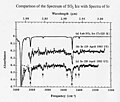 Use of absorption spectroscopy to identify ices in the solar system.
 -
 Cumulative absorption spectrum from the Hubble Space Telescope.


Ad. Transform your life with W8MD's
GLP-1 weight loss injections special from $29.99


W8MD Medical Weight Loss, Sleep and Medspa offers physician-supervised medical weight loss programs: NYC medical weight loss Philadelphia medical weight loss
Affordable GLP-1 Weight Loss ShotsAffordable GLP-1 Weight Loss Shots
Budget GLP-1 injections NYC (insurance & self-pay options) Popular treatments:
- Semaglutide starting from $29.99/week
- Tirzepatide starting from $45.00/week
✔ Most insurances accepted for visits ✔ Prior authorization support when eligible
Start your physician weight loss NYC journey today:
📍 NYC: Brooklyn weight loss center 📍 Philadelphia: Philadelphia weight loss center
📞 Call: 718-946-5500 (NYC) | 215-676-2334 (Philadelphia)
Tags: Affordable GLP1 weight loss NYC, Wegovy NYC, Zepbound NYC, Philadelphia medical weight loss


|
WikiMD Medical Encyclopedia |
Medical Disclaimer: WikiMD is not a substitute for professional medical advice. The information on WikiMD is provided as an information resource only, may be incorrect, outdated or misleading, and is not to be used or relied on for any diagnostic or treatment purposes. Please consult your health care provider before making any healthcare decisions or for guidance about a specific medical condition. WikiMD expressly disclaims responsibility, and shall have no liability, for any damages, loss, injury, or liability whatsoever suffered as a result of your reliance on the information contained in this site. By visiting this site you agree to the foregoing terms and conditions, which may from time to time be changed or supplemented by WikiMD. If you do not agree to the foregoing terms and conditions, you should not enter or use this site. See full disclaimer.
Credits:Most images are courtesy of Wikimedia commons, and templates, categories Wikipedia, licensed under CC BY SA or similar.
Translate this page: - East Asian
中文,
日本,
한국어,
South Asian
हिन्दी,
தமிழ்,
తెలుగు,
Urdu,
ಕನ್ನಡ,
Southeast Asian
Indonesian,
Vietnamese,
Thai,
မြန်မာဘာသာ,
বাংলা
European
español,
Deutsch,
français,
Greek,
português do Brasil,
polski,
română,
русский,
Nederlands,
norsk,
svenska,
suomi,
Italian
Middle Eastern & African
عربى,
Turkish,
Persian,
Hebrew,
Afrikaans,
isiZulu,
Kiswahili,
Other
Bulgarian,
Hungarian,
Czech,
Swedish,
മലയാളം,
मराठी,
ਪੰਜਾਬੀ,
ગુજરાતી,
Portuguese,
Ukrainian
