Arm span
Apocrypha
The term Apocrypha refers to a collection of ancient books with religious or historical significance that are not considered part of the canonical Bible by certain religious traditions. The status and acceptance of these texts vary among different Christian denominations and Jewish traditions.
Etymology and Definition
The word "apocrypha" comes from the Greek "_π_______" (apokryphos), meaning "hidden" or "obscure." Originally, it referred to texts that were "hidden away" because they were considered esoteric or not suitable for public reading. Over time, the term has come to denote texts that are outside the accepted canon of scripture.
Historical Context
The Apocrypha includes a variety of texts, such as historical works, wisdom literature, and additions to canonical books. These texts were primarily written during the intertestamental period, the time between the Old Testament and the New Testament.
Apocryphal Books
Some of the most well-known apocryphal books include:
- 1 Esdras
- 2 Esdras
- Tobit
- Judith
- Additions to Esther
- Wisdom of Solomon
- Ecclesiasticus, also known as the Book of Sirach
- Baruch
- Letter of Jeremiah
- Prayer of Azariah
- Susanna
- Bel and the Dragon
- 1 Maccabees
- 2 Maccabees
Canonical Status
The canonical status of the Apocrypha varies among different religious traditions:
- The Roman Catholic Church includes most of the Apocrypha in the Deuterocanonical books, which are considered part of the Old Testament.
- The Eastern Orthodox Church also accepts many of these texts, though the specific books included can vary.
- Most Protestant denominations do not consider the Apocrypha to be canonical, though they may be included in some editions of the Bible for historical or educational purposes.
- In Judaism, these texts are not part of the Hebrew Bible and are generally not considered authoritative.
Influence and Legacy
The Apocrypha has had a significant influence on Christian art, literature, and theology. Many of the stories and themes found in these texts have been depicted in art and literature throughout history. For example, the story of Judith and Holofernes has been a popular subject in Renaissance art.
Modern Usage
Today, the Apocrypha is often studied for its historical and cultural value. It provides insight into the religious and social context of the time in which it was written. Scholars and theologians continue to debate the significance and interpretation of these texts.
Related Pages
Gallery
-
 A page from a historical text discussing the Apocrypha.
 -
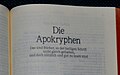 The Apocryphal books in a Luther Bible.
 -
 A page from the 1769 Oxford Edition of the King James Version, which includes the Apocrypha.
.jpg)

Ad. Transform your life with W8MD's Budget GLP-1 injections from $49.99


W8MD offers a medical weight loss program to lose weight in Philadelphia. Our physician-supervised medical weight loss provides:
- Weight loss injections in NYC (generic and brand names):
- Zepbound / Mounjaro, Wegovy / Ozempic, Saxenda
- Most insurances accepted or discounted self-pay rates. We will obtain insurance prior authorizations if needed.
- Generic GLP1 weight loss injections from $49.99 for the starting dose of Semaglutide and $65.00 for Tirzepatide.
- Also offer prescription weight loss medications including Phentermine, Qsymia, Diethylpropion, Contrave etc.
NYC weight loss doctor appointmentsNYC weight loss doctor appointments
Start your NYC weight loss journey today at our NYC medical weight loss and Philadelphia medical weight loss clinics.
- Call 718-946-5500 to lose weight in NYC or for medical weight loss in Philadelphia 215-676-2334.
- Tags:NYC medical weight loss, Philadelphia lose weight Zepbound NYC, Budget GLP1 weight loss injections, Wegovy Philadelphia, Wegovy NYC, Philadelphia medical weight loss, Brookly weight loss and Wegovy NYC


|
WikiMD's Wellness Encyclopedia |
| Let Food Be Thy Medicine Medicine Thy Food - Hippocrates |
Medical Disclaimer: WikiMD is not a substitute for professional medical advice. The information on WikiMD is provided as an information resource only, may be incorrect, outdated or misleading, and is not to be used or relied on for any diagnostic or treatment purposes. Please consult your health care provider before making any healthcare decisions or for guidance about a specific medical condition. WikiMD expressly disclaims responsibility, and shall have no liability, for any damages, loss, injury, or liability whatsoever suffered as a result of your reliance on the information contained in this site. By visiting this site you agree to the foregoing terms and conditions, which may from time to time be changed or supplemented by WikiMD. If you do not agree to the foregoing terms and conditions, you should not enter or use this site. See full disclaimer.
Credits:Most images are courtesy of Wikimedia commons, and templates, categories Wikipedia, licensed under CC BY SA or similar.
Translate this page: - East Asian
中文,
日本,
한국어,
South Asian
हिन्दी,
தமிழ்,
తెలుగు,
Urdu,
ಕನ್ನಡ,
Southeast Asian
Indonesian,
Vietnamese,
Thai,
မြန်မာဘာသာ,
বাংলা
European
español,
Deutsch,
français,
Greek,
português do Brasil,
polski,
română,
русский,
Nederlands,
norsk,
svenska,
suomi,
Italian
Middle Eastern & African
عربى,
Turkish,
Persian,
Hebrew,
Afrikaans,
isiZulu,
Kiswahili,
Other
Bulgarian,
Hungarian,
Czech,
Swedish,
മലയാളം,
मराठी,
ਪੰਜਾਬੀ,
ગુજરાતી,
Portuguese,
Ukrainian
