Large-cell acanthoma
Large-cell acanthoma is a benign skin lesion that is characterized by its large, pale-staining keratinocytes. It is a rare condition that is often mistaken for other skin conditions, such as actinic keratosis or squamous cell carcinoma.
History
Large-cell acanthoma was first described in 1968 by the dermatologist Robert Degos. It was initially thought to be a variant of seborrheic keratosis, but further studies have shown that it is a distinct entity.
Characteristics
Large-cell acanthoma typically presents as a solitary, well-demarcated, flat or slightly raised lesion. It is usually found on sun-exposed areas of the body, such as the face, neck, and arms. The lesion is often asymptomatic, but it may cause mild itching or discomfort.
Histologically, large-cell acanthoma is characterized by an increased number of large, pale-staining keratinocytes in the epidermis. These cells are larger than the surrounding keratinocytes and have a clear or pale cytoplasm. The dermis underneath the lesion may show signs of solar elastosis, indicating chronic sun damage.
Diagnosis
The diagnosis of large-cell acanthoma is usually made based on the clinical appearance of the lesion and the histological findings. A skin biopsy may be performed to confirm the diagnosis and to rule out other skin conditions.
Treatment
Treatment for large-cell acanthoma is usually not necessary, as the condition is benign and does not pose a risk for malignancy. However, if the lesion is bothersome or cosmetically unacceptable, it can be removed by surgical excision or cryotherapy.
See also
 | This dermatology article is a stub. You can help Wikipedia by adding missing information. |
 | This medical article is a stub. You can help Wikipedia by adding missing information. |
-
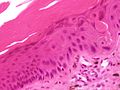 Large-cell acanthoma

Ad. Transform your health with W8MD Weight Loss, Sleep & MedSpa

Tired of being overweight?
Special offer:
Budget GLP-1 weight loss medications
- Semaglutide starting from $29.99/week and up with insurance for visit of $59.99 and up per week self pay.
- Tirzepatide starting from $45.00/week and up (dose dependent) or $69.99/week and up self pay
✔ Same-week appointments, evenings & weekends
Learn more:
- GLP-1 weight loss clinic NYC
- W8MD's NYC medical weight loss
- W8MD Philadelphia GLP-1 shots
- Philadelphia GLP-1 injections
- Affordable GLP-1 shots NYC
- Budget GLP-1 shots
|
WikiMD Medical Encyclopedia |
Medical Disclaimer: WikiMD is for informational purposes only and is not a substitute for professional medical advice. Content may be inaccurate or outdated and should not be used for diagnosis or treatment. Always consult your healthcare provider for medical decisions. Verify information with trusted sources such as CDC.gov and NIH.gov. By using this site, you agree that WikiMD is not liable for any outcomes related to its content. See full disclaimer.
Credits:Most images are courtesy of Wikimedia commons, and templates, categories Wikipedia, licensed under CC BY SA or similar.
Translate this page: - East Asian
中文,
日本,
한국어,
South Asian
हिन्दी,
தமிழ்,
తెలుగు,
Urdu,
ಕನ್ನಡ,
Southeast Asian
Indonesian,
Vietnamese,
Thai,
မြန်မာဘာသာ,
বাংলা
European
español,
Deutsch,
français,
Greek,
português do Brasil,
polski,
română,
русский,
Nederlands,
norsk,
svenska,
suomi,
Italian
Middle Eastern & African
عربى,
Turkish,
Persian,
Hebrew,
Afrikaans,
isiZulu,
Kiswahili,
Other
Bulgarian,
Hungarian,
Czech,
Swedish,
മലയാളം,
मराठी,
ਪੰਜਾਬੀ,
ગુજરાતી,
Portuguese,
Ukrainian
