Anaplastic large-cell lymphoma
Anaplastic_large-cell_lymphoma
-
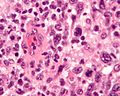 Anaplastic large-cell lymphoma under very high magnification
 -
 Anaplastic large-cell lymphoma CD30 positive


Anaplastic Large-Cell Lymphoma
Anaplastic large-cell lymphoma (ALCL) is a type of non-Hodgkin lymphoma that is characterized by the presence of large, atypical lymphoid cells. It is a rare form of lymphoma that can occur in both children and adults. ALCL is classified as a T-cell lymphoma, meaning it originates from T lymphocytes, a type of white blood cell that plays a crucial role in the immune system.
Classification
ALCL is divided into two main types based on the presence or absence of a specific genetic abnormality involving the anaplastic lymphoma kinase (ALK) gene:
- ALK-positive ALCL: This type is more common in children and young adults. It is characterized by the presence of a translocation involving the ALK gene, which leads to the expression of an abnormal ALK protein that promotes cell growth and survival.
- ALK-negative ALCL: This type is more common in older adults and does not have the ALK gene rearrangement. It tends to have a more aggressive clinical course compared to ALK-positive ALCL.
Clinical Presentation
Patients with ALCL may present with a variety of symptoms, including:
- Lymphadenopathy: Swelling of the lymph nodes, which may be painless.
- B symptoms: Fever, night sweats, and weight loss.
- Extranodal involvement: ALCL can affect organs outside the lymphatic system, such as the skin, liver, lungs, and bones.
Diagnosis
The diagnosis of ALCL is made through a combination of clinical evaluation, imaging studies, and biopsy of affected tissue. Histological examination reveals large, pleomorphic cells with abundant cytoplasm and horseshoe-shaped nuclei. Immunohistochemistry is used to detect the expression of CD30, a marker that is typically positive in ALCL cells.
Treatment
The treatment of ALCL depends on the subtype and stage of the disease. Common treatment options include:
- Chemotherapy: Regimens such as CHOP (cyclophosphamide, doxorubicin, vincristine, and prednisone) are commonly used.
- Targeted therapy: For ALK-positive ALCL, ALK inhibitors such as crizotinib may be used.
- Radiation therapy: May be used in certain cases, especially for localized disease.
- Stem cell transplantation: Considered in cases of relapsed or refractory ALCL.
Prognosis
The prognosis of ALCL varies depending on the subtype and other factors such as age and overall health. ALK-positive ALCL generally has a better prognosis compared to ALK-negative ALCL. Long-term survival rates are higher in children and young adults compared to older patients.
Related Pages
| Lymphomas | ||||||||
|---|---|---|---|---|---|---|---|---|
This lymphoma-related article is a stub.
|
Ad. Transform your life with W8MD's
GLP-1 weight loss injections special from $29.99 with insurance
|
WikiMD Medical Encyclopedia |
Medical Disclaimer: WikiMD is for informational purposes only and is not a substitute for professional medical advice. Content may be inaccurate or outdated and should not be used for diagnosis or treatment. Always consult your healthcare provider for medical decisions. Verify information with trusted sources such as CDC.gov and NIH.gov. By using this site, you agree that WikiMD is not liable for any outcomes related to its content. See full disclaimer.
Credits:Most images are courtesy of Wikimedia commons, and templates, categories Wikipedia, licensed under CC BY SA or similar.
Translate this page: - East Asian
中文,
日本,
한국어,
South Asian
हिन्दी,
தமிழ்,
తెలుగు,
Urdu,
ಕನ್ನಡ,
Southeast Asian
Indonesian,
Vietnamese,
Thai,
မြန်မာဘာသာ,
বাংলা
European
español,
Deutsch,
français,
Greek,
português do Brasil,
polski,
română,
русский,
Nederlands,
norsk,
svenska,
suomi,
Italian
Middle Eastern & African
عربى,
Turkish,
Persian,
Hebrew,
Afrikaans,
isiZulu,
Kiswahili,
Other
Bulgarian,
Hungarian,
Czech,
Swedish,
മലയാളം,
मराठी,
ਪੰਜਾਬੀ,
ગુજરાતી,
Portuguese,
Ukrainian
