USB
Universal Serial Bus (USB)
The Universal Serial Bus (USB) is an industry standard that establishes specifications for cables, connectors, and protocols for connection, communication, and power supply between computers, peripherals, and other computers. USB was designed to standardize the connection of peripherals to personal computers, both to communicate and to supply electric power. It has largely replaced interfaces such as serial ports and parallel ports, and has become commonplace on a wide range of devices.
History
USB was developed in the mid-1990s by a group of seven companies: Compaq, DEC, IBM, Intel, Microsoft, NEC, and Nortel. The goal was to simplify the connection of external devices to computers by replacing the multitude of connectors at the back of PCs, addressing usability issues, and simplifying software configuration of all devices connected to USB, as well as permitting greater data transfer rates for external devices.
Versions
USB has evolved through several versions:
- USB 1.0: Released in January 1996, it had a data transfer rate of 1.5 Mbit/s (Low Speed) and 12 Mbit/s (Full Speed).
- USB 2.0: Released in April 2000, it increased the data transfer rate to 480 Mbit/s (High Speed).
- USB 3.0: Released in November 2008, it introduced a new transfer rate called SuperSpeed USB (5 Gbit/s).
- USB 3.1: Released in July 2013, it introduced SuperSpeed+ (10 Gbit/s).
- USB 3.2: Released in September 2017, it further increased the data transfer rate to 20 Gbit/s.
- USB4: Announced in August 2019, it supports data transfer rates up to 40 Gbit/s.
Connectors
USB connectors have evolved over time, with several types being used:
- USB Type-A: The original USB connector, widely used in computers and other devices.
- USB Type-B: Commonly used for printers and other powered devices.
- USB Mini and Micro: Smaller connectors used for mobile devices.
- USB Type-C: A reversible connector that supports higher power and data transfer rates.
Power and Charging
USB was designed to allow many peripherals to be connected using a single standardized interface socket and to improve plug-and-play capabilities by allowing hot swapping. USB can supply power to low-consumption devices, eliminating the need for a separate power supply cable.
Applications
USB is used in a wide variety of applications, including:
- Connecting peripherals such as keyboards, mice, and printers to computers.
- Charging and data transfer for mobile devices.
- External storage devices such as USB flash drives and external hard drives.
- Audio and video devices, including webcams and microphones.
Related pages
References
- "Universal Serial Bus (USB) Information." USB.org. Accessed October 2023.
- "USB Implementers Forum." USB-IF. Accessed October 2023.
Gallery
-
 USB Type-C on a MacBook
 -
 Certified USB logo
 -
 USB Type-A receptacle (white)
 -
 USB 3.0 Type-A receptacle (blue)
 -
 USB Type-B receptacle
 -
 USB 3.0 Type-B receptacle (blue)
 -
 USB Mini-A receptacle
 -
 USB Micro-A receptacle
 -
 USB Type-C receptacle pinout
 -
 USB icon
 -
 SanDisk Cruzer USB thumb drive
 -
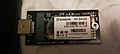 M.2 SSD connected to USB 3.0 adapter
 -
 Various USB cables
 -
 USB 5Gbps logo
 -
 USB 10Gbps logo
 -
 USB 20Gbps logo
 -
 USB 40Gbps logo
 -
 USB 80Gbps logo
 -
 USB Wireless certified logo


-
USB Type-C MacBook
-
Certified USB
-
USB Type-A Receptacle White
-
 USB Type-A Receptacle Black
 -
USB 3.0 Type-A Receptacle Blue
-
USB Type-B Receptacle
-
USB 3.0 Type-B Receptacle Blue
-
USB Mini-A Receptacle
-
 USB Mini-AB Receptacle
 -
 USB Mini-B Receptacle
 -
USB Micro-A
-
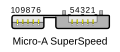 USB 3.0 Micro-A


Ad. Transform your life with W8MD's Budget GLP-1 injections from $75


W8MD offers a medical weight loss program to lose weight in Philadelphia. Our physician-supervised medical weight loss provides:
- Weight loss injections in NYC (generic and brand names):
- Zepbound / Mounjaro, Wegovy / Ozempic, Saxenda
- Most insurances accepted or discounted self-pay rates. We will obtain insurance prior authorizations if needed.
- Generic GLP1 weight loss injections from $75 for the starting dose.
- Also offer prescription weight loss medications including Phentermine, Qsymia, Diethylpropion, Contrave etc.
NYC weight loss doctor appointmentsNYC weight loss doctor appointments
Start your NYC weight loss journey today at our NYC medical weight loss and Philadelphia medical weight loss clinics.
- Call 718-946-5500 to lose weight in NYC or for medical weight loss in Philadelphia 215-676-2334.
- Tags:NYC medical weight loss, Philadelphia lose weight Zepbound NYC, Budget GLP1 weight loss injections, Wegovy Philadelphia, Wegovy NYC, Philadelphia medical weight loss, Brookly weight loss and Wegovy NYC


|
WikiMD's Wellness Encyclopedia |
| Let Food Be Thy Medicine Medicine Thy Food - Hippocrates |
Medical Disclaimer: WikiMD is not a substitute for professional medical advice. The information on WikiMD is provided as an information resource only, may be incorrect, outdated or misleading, and is not to be used or relied on for any diagnostic or treatment purposes. Please consult your health care provider before making any healthcare decisions or for guidance about a specific medical condition. WikiMD expressly disclaims responsibility, and shall have no liability, for any damages, loss, injury, or liability whatsoever suffered as a result of your reliance on the information contained in this site. By visiting this site you agree to the foregoing terms and conditions, which may from time to time be changed or supplemented by WikiMD. If you do not agree to the foregoing terms and conditions, you should not enter or use this site. See full disclaimer.
Credits:Most images are courtesy of Wikimedia commons, and templates, categories Wikipedia, licensed under CC BY SA or similar.
Translate this page: - East Asian
中文,
日本,
한국어,
South Asian
हिन्दी,
தமிழ்,
తెలుగు,
Urdu,
ಕನ್ನಡ,
Southeast Asian
Indonesian,
Vietnamese,
Thai,
မြန်မာဘာသာ,
বাংলা
European
español,
Deutsch,
français,
Greek,
português do Brasil,
polski,
română,
русский,
Nederlands,
norsk,
svenska,
suomi,
Italian
Middle Eastern & African
عربى,
Turkish,
Persian,
Hebrew,
Afrikaans,
isiZulu,
Kiswahili,
Other
Bulgarian,
Hungarian,
Czech,
Swedish,
മലയാളം,
मराठी,
ਪੰਜਾਬੀ,
ગુજરાતી,
Portuguese,
Ukrainian
