Capillaria hepatica
Capillaria hepatica is a parasitic nematode that primarily affects the liver of various mammalian hosts, including humans. It is a member of the family Trichuridae, which also includes other parasitic worms such as Trichuris trichiura and Trichinella spiralis.
Life Cycle
The life cycle of Capillaria hepatica is unique among parasitic nematodes. The adult worms live in the liver of the host, where they produce eggs that are released into the environment through the host's feces. These eggs can survive in the environment for years, and are ingested by a new host to complete the life cycle.
Pathology
Infection with Capillaria hepatica can cause hepatitis, cirrhosis, and other serious liver diseases. The severity of the disease depends on the number of worms present in the liver and the host's immune response. In severe cases, infection can lead to death.
Diagnosis and Treatment
Diagnosis of Capillaria hepatica infection is typically made by identifying the characteristic eggs in a stool sample. Treatment usually involves anthelmintic drugs, such as mebendazole or albendazole, which kill the adult worms.
Epidemiology
Capillaria hepatica is found worldwide, but is most common in tropical and subtropical regions where sanitation is poor. Humans can become infected by ingesting contaminated food or water, or by direct contact with contaminated soil.
Prevention
Prevention of Capillaria hepatica infection involves improving sanitation and educating people about the risks of consuming contaminated food or water. In areas where the parasite is common, regular deworming programs can also help to reduce the prevalence of infection.
See Also
 | This article related to parasites is a stub. You can help WikiMD by expanding the page. |
 | This medical article is a stub. You can help WikiMD by expanding the page. |
-
 Capillaria hepatica
 -
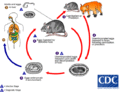 Lifecycle of Capillaria hepatica
 -
 Cysts of Capillaria hepatica


-
 Capillaria hepatica
 -
Capillaria hepatica
-
Lifecycle of Capillaria hepatica
-
Cysts of Capillaria hepatica

Medical Disclaimer: WikiMD is for informational purposes only and is not a substitute for professional medical advice. Content may be inaccurate or outdated and should not be used for diagnosis or treatment. Always consult your healthcare provider for medical decisions. Verify information with trusted sources such as CDC.gov and NIH.gov. By using this site, you agree that WikiMD is not liable for any outcomes related to its content. See full disclaimer.
Credits:Most images are courtesy of Wikimedia commons, and templates, categories Wikipedia, licensed under CC BY SA or similar.
Translate this page: - East Asian
中文,
日本,
한국어,
South Asian
हिन्दी,
தமிழ்,
తెలుగు,
Urdu,
ಕನ್ನಡ,
Southeast Asian
Indonesian,
Vietnamese,
Thai,
မြန်မာဘာသာ,
বাংলা
European
español,
Deutsch,
français,
Greek,
português do Brasil,
polski,
română,
русский,
Nederlands,
norsk,
svenska,
suomi,
Italian
Middle Eastern & African
عربى,
Turkish,
Persian,
Hebrew,
Afrikaans,
isiZulu,
Kiswahili,
Other
Bulgarian,
Hungarian,
Czech,
Swedish,
മലയാളം,
मराठी,
ਪੰਜਾਬੀ,
ગુજરાતી,
Portuguese,
Ukrainian
