Bromfenac
Bromfenac is a nonsteroidal anti-inflammatory drug (NSAID) with analgesic and anti-inflammatory properties. It is primarily used in ophthalmology to treat postoperative inflammation and reduce pain in patients who have undergone cataract surgery. Bromfenac works by inhibiting the action of cyclooxygenase (COX) enzymes, which are involved in the synthesis of prostaglandins, substances that mediate inflammation and pain.
Pharmacology
Bromfenac is a potent inhibitor of the COX enzymes, with a slightly higher selectivity for COX-2 over COX-1. The inhibition of these enzymes leads to a decrease in the production of prostaglandins, which are key mediators of inflammation and pain. By reducing the levels of prostaglandins, bromfenac effectively reduces inflammation and alleviates pain.
Indications
The primary indication for bromfenac is the treatment of postoperative inflammation and pain in patients who have undergone cataract surgery. It is administered as an ophthalmic solution. Bromfenac may also be used for other conditions as determined by a healthcare provider.
Dosage and Administration
Bromfenac is available as an ophthalmic solution, typically in a concentration of 0.07% or 0.09%. The recommended dosage for the treatment of postoperative inflammation and pain following cataract surgery is one drop in the affected eye(s) twice daily, beginning 24 hours after surgery and continuing for the first 14 days postoperatively.
Side Effects
Common side effects of bromfenac include:
- Eye irritation
- Mild to moderate eye pain
- Redness
- Headache
Serious side effects are rare but may include:
- Increased eye pressure
- Corneal damage
- Hypersensitivity reactions
Patients should be advised to report any severe or persistent side effects to their healthcare provider.
Contraindications
Bromfenac is contraindicated in patients with known hypersensitivity to bromfenac, other NSAIDs, or any component of the formulation. It should be used with caution in patients with a history of severe allergic reactions to NSAIDs.
Drug Interactions
Bromfenac may interact with other medications, including other topical ophthalmic medications. It is important to inform the healthcare provider of all medications being used, including over-the-counter drugs and herbal supplements, to avoid potential drug interactions.
Precautions
Patients using bromfenac should be monitored for signs of increased eye pressure and corneal damage. The use of contact lenses is not recommended during treatment with bromfenac ophthalmic solution.
Pharmacokinetics
Bromfenac is rapidly absorbed through the cornea and reaches peak concentrations in the aqueous humor. It is metabolized in the liver and excreted primarily in the urine.
Conclusion
Bromfenac is an effective NSAID for the treatment of postoperative inflammation and pain following cataract surgery. Its use should be guided by a healthcare provider, with consideration given to potential side effects, contraindications, and drug interactions.


-
 Bromfenac chemical structure
 -
 Bromfenac cyclic amide structure
 -
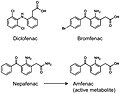 Comparison of Bromfenac and Amfenac

Ad. Transform your life with W8MD's Budget GLP-1 injections from $75


W8MD offers a medical weight loss program to lose weight in Philadelphia. Our physician-supervised medical weight loss provides:
- Weight loss injections in NYC (generic and brand names):
- Zepbound / Mounjaro, Wegovy / Ozempic, Saxenda
- Most insurances accepted or discounted self-pay rates. We will obtain insurance prior authorizations if needed.
- Generic GLP1 weight loss injections from $75 for the starting dose.
- Also offer prescription weight loss medications including Phentermine, Qsymia, Diethylpropion, Contrave etc.
NYC weight loss doctor appointmentsNYC weight loss doctor appointments
Start your NYC weight loss journey today at our NYC medical weight loss and Philadelphia medical weight loss clinics.
- Call 718-946-5500 to lose weight in NYC or for medical weight loss in Philadelphia 215-676-2334.
- Tags:NYC medical weight loss, Philadelphia lose weight Zepbound NYC, Budget GLP1 weight loss injections, Wegovy Philadelphia, Wegovy NYC, Philadelphia medical weight loss, Brookly weight loss and Wegovy NYC


|
WikiMD's Wellness Encyclopedia |
| Let Food Be Thy Medicine Medicine Thy Food - Hippocrates |
Medical Disclaimer: WikiMD is not a substitute for professional medical advice. The information on WikiMD is provided as an information resource only, may be incorrect, outdated or misleading, and is not to be used or relied on for any diagnostic or treatment purposes. Please consult your health care provider before making any healthcare decisions or for guidance about a specific medical condition. WikiMD expressly disclaims responsibility, and shall have no liability, for any damages, loss, injury, or liability whatsoever suffered as a result of your reliance on the information contained in this site. By visiting this site you agree to the foregoing terms and conditions, which may from time to time be changed or supplemented by WikiMD. If you do not agree to the foregoing terms and conditions, you should not enter or use this site. See full disclaimer.
Credits:Most images are courtesy of Wikimedia commons, and templates, categories Wikipedia, licensed under CC BY SA or similar.
Translate this page: - East Asian
中文,
日本,
한국어,
South Asian
हिन्दी,
தமிழ்,
తెలుగు,
Urdu,
ಕನ್ನಡ,
Southeast Asian
Indonesian,
Vietnamese,
Thai,
မြန်မာဘာသာ,
বাংলা
European
español,
Deutsch,
français,
Greek,
português do Brasil,
polski,
română,
русский,
Nederlands,
norsk,
svenska,
suomi,
Italian
Middle Eastern & African
عربى,
Turkish,
Persian,
Hebrew,
Afrikaans,
isiZulu,
Kiswahili,
Other
Bulgarian,
Hungarian,
Czech,
Swedish,
മലയാളം,
मराठी,
ਪੰਜਾਬੀ,
ગુજરાતી,
Portuguese,
Ukrainian
