Kallidin
Kallidin is a bioactive peptide that is a member of the kinin family of proteins. It is a decapeptide that is produced from kininogen by the action of the enzyme kallikrein. Kallidin is a potent vasodilator, meaning it can widen blood vessels and increase blood flow. It also has other effects, such as promoting inflammation and pain sensation.
Structure and Function
Kallidin is a decapeptide, meaning it is composed of ten amino acids. Its sequence is Arg-Pro-Pro-Gly-Phe-Ser-Pro-Phe-Arg. This sequence is identical to that of bradykinin, another member of the kinin family, except that kallidin has an additional lysine residue at the N-terminal end.
The function of kallidin is primarily as a vasodilator. It achieves this by binding to bradykinin receptors on the surface of cells in the blood vessels, which triggers a series of reactions that result in the relaxation of the smooth muscle cells in the vessel walls. This causes the vessels to widen, increasing blood flow.
Kallidin also has other effects. It can promote inflammation by increasing the permeability of blood vessels, allowing immune cells and other substances to enter tissues more easily. It can also stimulate pain sensation by acting on nerve cells.
Production and Regulation
Kallidin is produced from kininogen, a protein that is present in the blood. The conversion of kininogen to kallidin is catalyzed by the enzyme kallikrein. This reaction is part of the kallikrein-kinin system, a complex network of proteins that regulate blood pressure, inflammation, and other processes.
The production of kallidin is tightly regulated by the body. Factors that can increase its production include stress, injury, and certain diseases. Conversely, its production can be reduced by drugs that inhibit the action of kallikrein, such as ACE inhibitors.
Clinical Significance
Due to its effects on blood vessels and inflammation, kallidin has been implicated in a number of diseases. These include hypertension, heart disease, and certain types of cancer. It is also thought to play a role in the pain and swelling associated with conditions such as arthritis and gout.
Research is ongoing to develop drugs that can modulate the activity of kallidin for therapeutic purposes. These include drugs that can inhibit its production or block its effects, as well as drugs that can enhance its activity in cases where this might be beneficial.
.svg)
This article is a biochemistry stub. You can help WikiMD by expanding it!

Kallidin
-
 Kallidin
 -
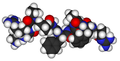 Kallidin 3D


Ad. Transform your life with W8MD's
GLP-1 weight loss injections special from $29.99 with insurance
|
WikiMD Medical Encyclopedia |
Medical Disclaimer: WikiMD is for informational purposes only and is not a substitute for professional medical advice. Content may be inaccurate or outdated and should not be used for diagnosis or treatment. Always consult your healthcare provider for medical decisions. Verify information with trusted sources such as CDC.gov and NIH.gov. By using this site, you agree that WikiMD is not liable for any outcomes related to its content. See full disclaimer.
Credits:Most images are courtesy of Wikimedia commons, and templates, categories Wikipedia, licensed under CC BY SA or similar.
Translate this page: - East Asian
中文,
日本,
한국어,
South Asian
हिन्दी,
தமிழ்,
తెలుగు,
Urdu,
ಕನ್ನಡ,
Southeast Asian
Indonesian,
Vietnamese,
Thai,
မြန်မာဘာသာ,
বাংলা
European
español,
Deutsch,
français,
Greek,
português do Brasil,
polski,
română,
русский,
Nederlands,
norsk,
svenska,
suomi,
Italian
Middle Eastern & African
عربى,
Turkish,
Persian,
Hebrew,
Afrikaans,
isiZulu,
Kiswahili,
Other
Bulgarian,
Hungarian,
Czech,
Swedish,
മലയാളം,
मराठी,
ਪੰਜਾਬੀ,
ગુજરાતી,
Portuguese,
Ukrainian
