Hexyl acetate
Hexyl acetate is an organic compound that belongs to the esters group. It is a colorless liquid that is slightly soluble in water and is often used in the creation of fruit flavorings due to its fruity aroma, similar to that of apples or pears.
Chemical Structure
Hexyl acetate has the chemical formula C8H16O2. It is composed of a hexyl group (C6H13) and an acetic acid (CH3COOH) molecule. The hexyl group is attached to the acetic acid molecule through an ester linkage, which is a carbonyl (C=O) adjacent to an ether (R-O-R').
Production
Hexyl acetate is typically produced through the esterification of hexanol and acetic acid. This reaction is catalyzed by an acid, often sulfuric acid. The reaction can be represented as follows:
C6H13OH + CH3COOH → C6H13O2CCH3 + H2O
Uses
Due to its fruity aroma, hexyl acetate is commonly used in the food and beverage industry as a flavoring agent. It is also used in the production of perfumes and cosmetics due to its pleasant smell. In addition, it is used as a solvent in various industrial applications.
Safety
Hexyl acetate is generally considered safe for use in food and cosmetics. However, like many organic compounds, it can be harmful if ingested in large quantities or if it comes into contact with the eyes or skin. Therefore, proper safety measures should be taken when handling this compound.
See Also


Hexyl acetate gallery
-
 Hexyl acetate
 -
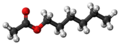 Hexyl acetate 3D ball


Ad. Transform your life with W8MD's
GLP-1 weight loss injections special from $29.99 with insurance
|
WikiMD Medical Encyclopedia |
Medical Disclaimer: WikiMD is for informational purposes only and is not a substitute for professional medical advice. Content may be inaccurate or outdated and should not be used for diagnosis or treatment. Always consult your healthcare provider for medical decisions. Verify information with trusted sources such as CDC.gov and NIH.gov. By using this site, you agree that WikiMD is not liable for any outcomes related to its content. See full disclaimer.
Credits:Most images are courtesy of Wikimedia commons, and templates, categories Wikipedia, licensed under CC BY SA or similar.
Translate this page: - East Asian
中文,
日本,
한국어,
South Asian
हिन्दी,
தமிழ்,
తెలుగు,
Urdu,
ಕನ್ನಡ,
Southeast Asian
Indonesian,
Vietnamese,
Thai,
မြန်မာဘာသာ,
বাংলা
European
español,
Deutsch,
français,
Greek,
português do Brasil,
polski,
română,
русский,
Nederlands,
norsk,
svenska,
suomi,
Italian
Middle Eastern & African
عربى,
Turkish,
Persian,
Hebrew,
Afrikaans,
isiZulu,
Kiswahili,
Other
Bulgarian,
Hungarian,
Czech,
Swedish,
മലയാളം,
मराठी,
ਪੰਜਾਬੀ,
ગુજરાતી,
Portuguese,
Ukrainian
