Folliculogenesis
Folliculogenesis
Folliculogenesis is the maturation process of the ovarian follicles, which are the basic units of female reproductive biology. Each follicle contains a single oocyte, or immature egg, and is surrounded by granulosa cells and theca cells. This process is crucial for female fertility and involves several stages of development, ultimately leading to ovulation.
Stages of Folliculogenesis
Folliculogenesis can be divided into several distinct stages:
Primordial Follicle Stage
The primordial follicle is the earliest stage of follicle development. It consists of a primary oocyte surrounded by a single layer of flattened granulosa cells. These follicles are formed during fetal development and remain dormant until they are recruited into the growing pool.
Primary Follicle Stage
In the primary follicle stage, the granulosa cells become cuboidal and begin to proliferate. The oocyte enlarges, and the zona pellucida, a glycoprotein layer, forms around it. This stage marks the beginning of follicular growth.
Secondary Follicle Stage
The secondary follicle stage is characterized by the formation of multiple layers of granulosa cells and the development of the theca layer. The theca cells differentiate into theca interna and theca externa, which play a role in hormone production.
Antral Follicle Stage
The antral follicle, or tertiary follicle, stage is marked by the formation of a fluid-filled cavity called the antrum. The follicle increases in size, and the granulosa cells continue to proliferate. The antral follicle is responsive to follicle-stimulating hormone (FSH), which is crucial for its further development.
Preovulatory (Graafian) Follicle Stage
The Graafian follicle is the final stage of follicular development before ovulation. It is characterized by a large antrum and a mature oocyte. The surge in luteinizing hormone (LH) triggers ovulation, releasing the oocyte from the follicle.
Hormonal Regulation
Folliculogenesis is tightly regulated by a complex interplay of hormones:
- Follicle-Stimulating Hormone (FSH): Stimulates the growth and maturation of ovarian follicles.
- Luteinizing Hormone (LH): Triggers ovulation and the formation of the corpus luteum.
- Estrogen: Produced by the granulosa cells, it regulates the growth of the endometrium and provides feedback to the hypothalamus and pituitary gland.
- Progesterone: Secreted by the corpus luteum post-ovulation, it prepares the endometrium for potential implantation.
Clinical Significance
Disruptions in folliculogenesis can lead to various reproductive disorders, such as polycystic ovary syndrome (PCOS), premature ovarian failure, and infertility. Understanding the mechanisms of folliculogenesis is essential for developing treatments for these conditions.
Related Pages
-
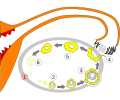 Order of changes in ovary
 -
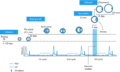 Folliculogenesis chart
 -
 Figure 28 02 04
 -
Follicle histology 1
-
Follicle histology 2
-
 Non-Growing Follicles
 -
 Gray 1163
 -
 Primary follicle (transition)


.jpg)
Ad. Transform your life with W8MD's
GLP-1 weight loss injections special from $29.99 with insurance
|
WikiMD Medical Encyclopedia |
Medical Disclaimer: WikiMD is for informational purposes only and is not a substitute for professional medical advice. Content may be inaccurate or outdated and should not be used for diagnosis or treatment. Always consult your healthcare provider for medical decisions. Verify information with trusted sources such as CDC.gov and NIH.gov. By using this site, you agree that WikiMD is not liable for any outcomes related to its content. See full disclaimer.
Credits:Most images are courtesy of Wikimedia commons, and templates, categories Wikipedia, licensed under CC BY SA or similar.
Translate this page: - East Asian
中文,
日本,
한국어,
South Asian
हिन्दी,
தமிழ்,
తెలుగు,
Urdu,
ಕನ್ನಡ,
Southeast Asian
Indonesian,
Vietnamese,
Thai,
မြန်မာဘာသာ,
বাংলা
European
español,
Deutsch,
français,
Greek,
português do Brasil,
polski,
română,
русский,
Nederlands,
norsk,
svenska,
suomi,
Italian
Middle Eastern & African
عربى,
Turkish,
Persian,
Hebrew,
Afrikaans,
isiZulu,
Kiswahili,
Other
Bulgarian,
Hungarian,
Czech,
Swedish,
മലയാളം,
मराठी,
ਪੰਜਾਬੀ,
ગુજરાતી,
Portuguese,
Ukrainian


