Abducens nucleus
Abducens nucleus

The abducens nucleus is a collection of neurons located in the pons, a part of the brainstem. It is responsible for controlling the lateral rectus muscle of the eye, which is involved in eye movement. The abducens nucleus is associated with the abducens nerve (cranial nerve VI), which innervates the lateral rectus muscle.
Anatomy

The abducens nucleus is situated in the caudal part of the pons, near the midline, and beneath the floor of the fourth ventricle. It is located at the level of the facial colliculus, which is formed by the fibers of the facial nerve (cranial nerve VII) looping over the abducens nucleus.
Function
The primary function of the abducens nucleus is to control the lateral rectus muscle, which abducts the eye, meaning it moves the eye away from the midline. This action is crucial for horizontal gaze and coordination of eye movements.
Neural connections

The abducens nucleus receives input from the paramedian pontine reticular formation (PPRF), which is involved in horizontal gaze control. It also has connections with the oculomotor nucleus via the medial longitudinal fasciculus (MLF), allowing for coordinated movement of both eyes.
Clinical significance
Lesions affecting the abducens nucleus can result in horizontal gaze palsy or internuclear ophthalmoplegia, depending on the extent and location of the damage. Such lesions can be caused by stroke, multiple sclerosis, or other neurological disorders.
Related structures
The abducens nucleus is closely related to the facial nerve due to its anatomical proximity. The fibers of the facial nerve loop over the abducens nucleus, forming the facial colliculus. This relationship is important in understanding certain clinical syndromes, such as Millard-Gubler syndrome, where both the abducens and facial nerves are affected.
Related pages
Gallery
-
 Diagram of the brainstem showing the abducens nucleus.
 -
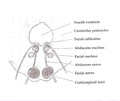 Cross-section of the pons at the level of the facial colliculus.
 -
 Diagram illustrating the neural pathways involving the abducens nucleus.
 -
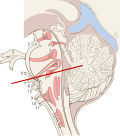 Sagittal section of the brainstem showing the location of the abducens nucleus.
 -
 Horizontal section of the lower pons showing the abducens nucleus.


Ad. Transform your life with W8MD's
GLP-1 weight loss injections special from $29.99 with insurance
|
WikiMD Medical Encyclopedia |
Medical Disclaimer: WikiMD is for informational purposes only and is not a substitute for professional medical advice. Content may be inaccurate or outdated and should not be used for diagnosis or treatment. Always consult your healthcare provider for medical decisions. Verify information with trusted sources such as CDC.gov and NIH.gov. By using this site, you agree that WikiMD is not liable for any outcomes related to its content. See full disclaimer.
Credits:Most images are courtesy of Wikimedia commons, and templates, categories Wikipedia, licensed under CC BY SA or similar.
Translate this page: - East Asian
中文,
日本,
한국어,
South Asian
हिन्दी,
தமிழ்,
తెలుగు,
Urdu,
ಕನ್ನಡ,
Southeast Asian
Indonesian,
Vietnamese,
Thai,
မြန်မာဘာသာ,
বাংলা
European
español,
Deutsch,
français,
Greek,
português do Brasil,
polski,
română,
русский,
Nederlands,
norsk,
svenska,
suomi,
Italian
Middle Eastern & African
عربى,
Turkish,
Persian,
Hebrew,
Afrikaans,
isiZulu,
Kiswahili,
Other
Bulgarian,
Hungarian,
Czech,
Swedish,
മലയാളം,
मराठी,
ਪੰਜਾਬੀ,
ગુજરાતી,
Portuguese,
Ukrainian
