Alar plate
Alar Plate
The alar plate is a critical structure in the developing central nervous system of vertebrates. It is part of the neural tube, which eventually forms the brain and spinal cord. The alar plate is primarily involved in the development of sensory neurons and is located dorsally in the neural tube.
Development
During embryogenesis, the neural tube forms from the neural ectoderm through a process called neurulation. The neural tube is initially a simple, hollow structure, but it soon differentiates into distinct regions. The alar plate is one of these regions, situated dorsally, while the basal plate is located ventrally.
The alar plate gives rise to the dorsal horn of the spinal cord, which is responsible for processing sensory information. In the brain, the alar plate contributes to the formation of structures such as the cerebellum and the thalamus.
Function
The primary function of the alar plate is to develop into structures that process sensory information. In the spinal cord, the neurons derived from the alar plate receive input from sensory neurons and are involved in the transmission of sensory signals to the brain.
In the brain, the alar plate contributes to the development of regions that are involved in sensory perception and integration. For example, the thalamus, which is derived from the alar plate, acts as a relay station for sensory information traveling to the cerebral cortex.
Clinical Significance
Abnormal development of the alar plate can lead to various neurological disorders. Since the alar plate is involved in the formation of sensory pathways, defects in its development can result in sensory processing issues. Understanding the development and function of the alar plate is crucial for diagnosing and treating such conditions.
Related Pages
Gallery
-
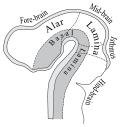 Diagram of the neural tube showing the alar plate.
 -
 Cross-section of the spinal cord illustrating the alar plate.


Ad. Transform your life with W8MD's
GLP-1 weight loss injections special from $29.99 with insurance
|
WikiMD Medical Encyclopedia |
Medical Disclaimer: WikiMD is for informational purposes only and is not a substitute for professional medical advice. Content may be inaccurate or outdated and should not be used for diagnosis or treatment. Always consult your healthcare provider for medical decisions. Verify information with trusted sources such as CDC.gov and NIH.gov. By using this site, you agree that WikiMD is not liable for any outcomes related to its content. See full disclaimer.
Credits:Most images are courtesy of Wikimedia commons, and templates, categories Wikipedia, licensed under CC BY SA or similar.
Translate this page: - East Asian
中文,
日本,
한국어,
South Asian
हिन्दी,
தமிழ்,
తెలుగు,
Urdu,
ಕನ್ನಡ,
Southeast Asian
Indonesian,
Vietnamese,
Thai,
မြန်မာဘာသာ,
বাংলা
European
español,
Deutsch,
français,
Greek,
português do Brasil,
polski,
română,
русский,
Nederlands,
norsk,
svenska,
suomi,
Italian
Middle Eastern & African
عربى,
Turkish,
Persian,
Hebrew,
Afrikaans,
isiZulu,
Kiswahili,
Other
Bulgarian,
Hungarian,
Czech,
Swedish,
മലയാളം,
मराठी,
ਪੰਜਾਬੀ,
ગુજરાતી,
Portuguese,
Ukrainian
