Amoeboid movement
-
 Amoeboid movement
 -
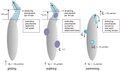 Types of amoeboid movement
 -
Collective mechanism of cell motion

Amoeboid Movement
Amoeboid movement is a type of cell motility characterized by the flowing motion of the cell's cytoplasm, allowing the cell to move and change shape. This form of movement is typical of amoebae, but it is also observed in other cell types, such as white blood cells in humans.
Mechanism
Amoeboid movement is primarily driven by the cytoskeleton, a network of protein filaments within the cell. The key components involved in this process are actin filaments and myosin motors. The movement can be described in several stages:
Protrusion
The cell extends a part of its membrane forward, forming a structure known as a pseudopod. This is achieved by the polymerization of actin filaments at the leading edge of the cell, pushing the membrane outward.
Adhesion
The pseudopod attaches to the substrate, providing a stable anchor point. This adhesion is mediated by cell surface proteins that interact with the extracellular matrix or other surfaces.
Traction
Once the pseudopod is anchored, the cell body is pulled forward. This is facilitated by the contraction of actin and myosin filaments, which generate the force needed to move the cell.
Detachment
Finally, the rear of the cell detaches from the substrate, allowing the cell to move forward. This detachment is regulated by the disassembly of adhesion sites and the depolymerization of actin filaments at the trailing edge.
Biological Significance
Amoeboid movement is crucial for various biological processes. In unicellular organisms like amoebae, it is essential for locomotion and feeding. In multicellular organisms, amoeboid movement plays a vital role in the immune response, allowing white blood cells to migrate towards sites of infection or inflammation. It is also involved in embryonic development and tissue repair.
Related Pages

This article is a cell biology stub. You can help WikiMD by expanding it!
Ad. Transform your life with W8MD's
GLP-1 weight loss injections special from $29.99 with insurance
|
WikiMD Medical Encyclopedia |
Medical Disclaimer: WikiMD is for informational purposes only and is not a substitute for professional medical advice. Content may be inaccurate or outdated and should not be used for diagnosis or treatment. Always consult your healthcare provider for medical decisions. Verify information with trusted sources such as CDC.gov and NIH.gov. By using this site, you agree that WikiMD is not liable for any outcomes related to its content. See full disclaimer.
Credits:Most images are courtesy of Wikimedia commons, and templates, categories Wikipedia, licensed under CC BY SA or similar.
Translate this page: - East Asian
中文,
日本,
한국어,
South Asian
हिन्दी,
தமிழ்,
తెలుగు,
Urdu,
ಕನ್ನಡ,
Southeast Asian
Indonesian,
Vietnamese,
Thai,
မြန်မာဘာသာ,
বাংলা
European
español,
Deutsch,
français,
Greek,
português do Brasil,
polski,
română,
русский,
Nederlands,
norsk,
svenska,
suomi,
Italian
Middle Eastern & African
عربى,
Turkish,
Persian,
Hebrew,
Afrikaans,
isiZulu,
Kiswahili,
Other
Bulgarian,
Hungarian,
Czech,
Swedish,
മലയാളം,
मराठी,
ਪੰਜਾਬੀ,
ગુજરાતી,
Portuguese,
Ukrainian

