Alternaria brassicae
-
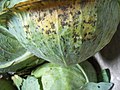 Symptoms of Alternaria brassicae on cabbage
 -
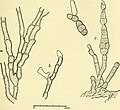 Alternaria brassicae
_Sacc._Symptoms_on_cabbage.JPG)

Alternaria brassicae
Alternaria brassicae is a fungal pathogen that primarily affects plants in the Brassicaceae family, which includes economically important crops such as cabbage, broccoli, cauliflower, and canola. This pathogen is responsible for causing the disease known as Alternaria leaf spot, which can lead to significant yield losses in affected crops.
Taxonomy
Alternaria brassicae belongs to the genus Alternaria, which is part of the family Pleosporaceae. The genus is known for its wide range of plant pathogenic species that affect various crops worldwide. Alternaria species are characterized by their production of darkly pigmented spores, which are often produced in chains.
Morphology
Alternaria brassicae produces conidia that are typically oblong to ellipsoid in shape, with transverse and longitudinal septa. These conidia are borne on conidiophores that emerge from the surface of infected plant tissues. The spores are darkly pigmented, which helps them survive in adverse environmental conditions.
Life Cycle
The life cycle of Alternaria brassicae involves both asexual and sexual reproduction, although the asexual stage is more commonly observed. The fungus overwinters as mycelium or conidia on plant debris or in the soil. In the presence of favorable conditions, such as high humidity and moderate temperatures, the conidia germinate and infect host plants.
Infection typically occurs through natural openings or wounds in the plant tissue. Once inside the host, the fungus colonizes the tissue, leading to the development of characteristic leaf spots. These spots can coalesce, causing large areas of necrosis and defoliation.
Symptoms
The primary symptom of Alternaria brassicae infection is the appearance of circular, dark brown to black spots on the leaves, stems, and pods of infected plants. These spots often have concentric rings, giving them a target-like appearance. As the disease progresses, the spots may enlarge and merge, leading to extensive tissue damage and premature leaf drop.
Epidemiology
Alternaria brassicae is favored by warm, humid conditions, which promote the germination of conidia and the spread of the disease. The pathogen can be disseminated by wind, rain splash, and contaminated equipment. Dense plant canopies and poor air circulation can exacerbate the spread of the disease.
Management
Management of Alternaria brassicae involves a combination of cultural, chemical, and biological control strategies. Cultural practices include crop rotation, removal of plant debris, and ensuring adequate plant spacing to improve air circulation. Fungicides can be used to protect plants, especially during periods of high disease pressure. Biological control agents, such as antagonistic fungi and bacteria, are also being explored as potential management options.
Related Pages

Ad. Transform your life with W8MD's
GLP-1 weight loss injections special from $29.99


W8MD Medical Weight Loss, Sleep and Medspa offers physician-supervised medical weight loss programs: NYC medical weight loss Philadelphia medical weight loss
Affordable GLP-1 Weight Loss ShotsAffordable GLP-1 Weight Loss Shots
Budget GLP-1 injections NYC (insurance & self-pay options) Popular treatments:
- Semaglutide starting from $29.99/week
- Tirzepatide starting from $45.00/week
✔ Most insurances accepted for visits ✔ Prior authorization support when eligible
Start your physician weight loss NYC journey today:
📍 NYC: Brooklyn weight loss center 📍 Philadelphia: Philadelphia weight loss center
📞 Call: 718-946-5500 (NYC) | 215-676-2334 (Philadelphia)
Tags: Affordable GLP1 weight loss NYC, Wegovy NYC, Zepbound NYC, Philadelphia medical weight loss


|
WikiMD Medical Encyclopedia |
Medical Disclaimer: WikiMD is not a substitute for professional medical advice. The information on WikiMD is provided as an information resource only, may be incorrect, outdated or misleading, and is not to be used or relied on for any diagnostic or treatment purposes. Please consult your health care provider before making any healthcare decisions or for guidance about a specific medical condition. WikiMD expressly disclaims responsibility, and shall have no liability, for any damages, loss, injury, or liability whatsoever suffered as a result of your reliance on the information contained in this site. By visiting this site you agree to the foregoing terms and conditions, which may from time to time be changed or supplemented by WikiMD. If you do not agree to the foregoing terms and conditions, you should not enter or use this site. See full disclaimer.
Credits:Most images are courtesy of Wikimedia commons, and templates, categories Wikipedia, licensed under CC BY SA or similar.
Translate this page: - East Asian
中文,
日本,
한국어,
South Asian
हिन्दी,
தமிழ்,
తెలుగు,
Urdu,
ಕನ್ನಡ,
Southeast Asian
Indonesian,
Vietnamese,
Thai,
မြန်မာဘာသာ,
বাংলা
European
español,
Deutsch,
français,
Greek,
português do Brasil,
polski,
română,
русский,
Nederlands,
norsk,
svenska,
suomi,
Italian
Middle Eastern & African
عربى,
Turkish,
Persian,
Hebrew,
Afrikaans,
isiZulu,
Kiswahili,
Other
Bulgarian,
Hungarian,
Czech,
Swedish,
മലയാളം,
मराठी,
ਪੰਜਾਬੀ,
ગુજરાતી,
Portuguese,
Ukrainian
