Adherens junction
Cell–cell junctions that connect the actin cytoskeleton of adjacent cells
Adherens junctions are a type of cell junction that play a crucial role in maintaining the structural integrity of tissues by connecting the actin cytoskeleton of adjacent cells. These junctions are essential for the formation and maintenance of tissues and are involved in various cellular processes, including cell signaling, cell adhesion, and tissue morphogenesis.
Structure
Adherens junctions are composed of cadherins, which are transmembrane proteins that mediate cell-cell adhesion. The extracellular domains of cadherins from adjacent cells interact in a calcium-dependent manner, forming a strong adhesive bond. The intracellular domains of cadherins are linked to the actin cytoskeleton through a complex of proteins, including catenins such as _-catenin, _-catenin, and p120-catenin.
Cadherins
Cadherins are a family of transmembrane proteins that are critical for the function of adherens junctions. They are characterized by their ability to bind calcium ions, which is necessary for their adhesive function. Different types of cadherins, such as E-cadherin, N-cadherin, and P-cadherin, are expressed in different tissues and contribute to tissue-specific adhesion properties.
Catenins
Catenins are cytoplasmic proteins that link cadherins to the actin cytoskeleton. _-catenin binds directly to the cytoplasmic domain of cadherins, while _-catenin connects _-catenin to actin filaments. p120-catenin regulates the stability and turnover of cadherins at the cell membrane.
Function
Adherens junctions are involved in several key functions:
- Cell adhesion: They provide strong adhesive contacts between cells, which is essential for the maintenance of tissue architecture.
- Signal transduction: Adherens junctions participate in signaling pathways that regulate cell behavior, including cell proliferation, differentiation, and migration.
- Tissue morphogenesis: During development, adherens junctions play a role in the shaping and organization of tissues by coordinating cell movements and rearrangements.
Role in Disease
Dysfunction of adherens junctions is implicated in various diseases, including cancer. Loss of E-cadherin function, for example, is associated with increased tumor invasiveness and metastasis. Additionally, mutations in catenin genes can lead to developmental disorders and contribute to the progression of certain cancers.
Related pages
Gallery
-
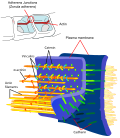 Diagram of adherens junctions showing structural proteins

Ad. Transform your life with W8MD's
GLP-1 weight loss injections special from $29.99 with insurance
|
WikiMD Medical Encyclopedia |
Medical Disclaimer: WikiMD is for informational purposes only and is not a substitute for professional medical advice. Content may be inaccurate or outdated and should not be used for diagnosis or treatment. Always consult your healthcare provider for medical decisions. Verify information with trusted sources such as CDC.gov and NIH.gov. By using this site, you agree that WikiMD is not liable for any outcomes related to its content. See full disclaimer.
Credits:Most images are courtesy of Wikimedia commons, and templates, categories Wikipedia, licensed under CC BY SA or similar.
Translate this page: - East Asian
中文,
日本,
한국어,
South Asian
हिन्दी,
தமிழ்,
తెలుగు,
Urdu,
ಕನ್ನಡ,
Southeast Asian
Indonesian,
Vietnamese,
Thai,
မြန်မာဘာသာ,
বাংলা
European
español,
Deutsch,
français,
Greek,
português do Brasil,
polski,
română,
русский,
Nederlands,
norsk,
svenska,
suomi,
Italian
Middle Eastern & African
عربى,
Turkish,
Persian,
Hebrew,
Afrikaans,
isiZulu,
Kiswahili,
Other
Bulgarian,
Hungarian,
Czech,
Swedish,
മലയാളം,
मराठी,
ਪੰਜਾਬੀ,
ગુજરાતી,
Portuguese,
Ukrainian
