Ventilator
Ventilator


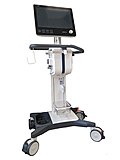
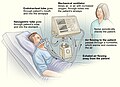
A ventilator is a machine designed to provide mechanical ventilation by moving breathable air into and out of the lungs, to deliver breaths to a patient who is physically unable to breathe, or breathing insufficiently. Modern ventilators are computerized microprocessor-controlled machines, but patients can also be ventilated with a simple, hand-operated bag valve mask.
History
The history of ventilators dates back to the 19th century with the development of the first mechanical ventilators. The East-Radcliffe Respirator was one of the early models used in hospitals. Over the years, technology has advanced significantly, leading to the development of sophisticated devices like the Hamilton C6.
Types of Ventilators
Ventilators can be classified into several types based on their operation and application:
- Closed-circuit ventilators: These systems are designed to provide a controlled environment for the patient, minimizing the risk of infection and contamination.
- Open-circuit ventilators: These are typically used in less controlled environments and may be more susceptible to external factors.
Functionality
Ventilators work by delivering a set volume of air to the patient at a controlled rate. The main parameters that can be adjusted include:
- Tidal volume: The amount of air delivered to the lungs with each breath.
- Respiratory rate: The number of breaths delivered per minute.
- Inspiratory pressure: The pressure applied to deliver the air into the lungs.
Applications
Ventilators are used in various medical settings, including:
- Intensive care units (ICUs): For patients with severe respiratory conditions.
- Operating rooms: To assist patients under anesthesia.
- Emergency medicine: For immediate respiratory support in critical situations.
Recent Developments
In response to the COVID-19 pandemic, there has been a surge in the development and production of ventilators. Notably, NASA developed the VITAL ventilator, a device specifically designed to address the needs of COVID-19 patients.
Related Pages
Gallery
-
 East-Radcliffe Respirator
 -
 Modern ventilator in use
 -
 NASA VITAL team
 -
 NASA VITAL ventilator
 -
 VITAL ventilators


```mediawiki
Ventilator
-
 Ventilator
 -
 Ventilator
 -
 Ventilator
 -
 Ventilator
 -
 Ventilator
 -
 Ventilator
 -
Ventilator
-
Ventilator
-
Ventilator
-
Ventilator
-
Ventilator
```
Ad. Transform your life with W8MD's
GLP-1 weight loss injections special from $29.99 with insurance
|
WikiMD Medical Encyclopedia |
Medical Disclaimer: WikiMD is for informational purposes only and is not a substitute for professional medical advice. Content may be inaccurate or outdated and should not be used for diagnosis or treatment. Always consult your healthcare provider for medical decisions. Verify information with trusted sources such as CDC.gov and NIH.gov. By using this site, you agree that WikiMD is not liable for any outcomes related to its content. See full disclaimer.
Credits:Most images are courtesy of Wikimedia commons, and templates, categories Wikipedia, licensed under CC BY SA or similar.
Translate this page: - East Asian
中文,
日本,
한국어,
South Asian
हिन्दी,
தமிழ்,
తెలుగు,
Urdu,
ಕನ್ನಡ,
Southeast Asian
Indonesian,
Vietnamese,
Thai,
မြန်မာဘာသာ,
বাংলা
European
español,
Deutsch,
français,
Greek,
português do Brasil,
polski,
română,
русский,
Nederlands,
norsk,
svenska,
suomi,
Italian
Middle Eastern & African
عربى,
Turkish,
Persian,
Hebrew,
Afrikaans,
isiZulu,
Kiswahili,
Other
Bulgarian,
Hungarian,
Czech,
Swedish,
മലയാളം,
मराठी,
ਪੰਜਾਬੀ,
ગુજરાતી,
Portuguese,
Ukrainian
