Functional magnetic resonance imaging
| Functional magnetic resonance imaging | |
|---|---|
| [[File:|250px|alt=|]] | |
| Pronunciation | |
| Synonyms | |
| Reference Range | |
| Calculator | |
| Purpose | |
| Test of | |
| Based on | |
| ICD-10-PCS | |
| ICD-9-CM | |
| MeSH | |
| OPS-301 Code | |
| Other Codes | |
| MedlinePlus | |
| eMedicine | |
| LOINC | |
| HCPCS-L2 | |
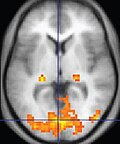
Functional magnetic resonance imaging (fMRI) is a neuroimaging procedure that measures and maps the brain's activity by detecting changes associated with blood flow. This technique relies on the fact that cerebral blood flow and neuronal activation are coupled. When an area of the brain is in use, blood flow to that region also increases. The primary form of fMRI uses the blood-oxygen-level-dependent (BOLD) contrast, which is sensitive to changes in the oxygenation of blood.
History
The development of fMRI in the 1990s was a significant breakthrough in the field of neuroscience. It evolved from earlier MRI scanning technology, incorporating the understanding that blood flow and neuronal activity are linked.
Principles
fMRI works by detecting the changes in blood oxygenation and flow that occur in response to neural activity. When a brain area is more active, it consumes more oxygen, and to meet this increased demand, blood flow increases to the active area. fMRI can thus capture images of the changing blood flow related to energy use by brain cells.
Applications
fMRI is used in both research and clinical settings:
- In research, fMRI is used to assess brain function, supporting studies on brain mapping and the understanding of various neurological and psychological phenomena.
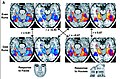
- Clinically, fMRI helps surgeons plan surgeries in critical brain areas, aids in the assessment of brain damage, and is used in the diagnosis of disorders like Alzheimer's disease and schizophrenia.
Procedure
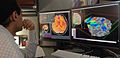
During an fMRI scan, the patient lies on a table that slides into a large tunnel-shaped scanner. They must remain still during the scan. Typically, the scan sequences are synchronized with tasks that the subject performs, which can involve answering questions, looking at images, or listening to sounds.
Advantages and Limitations
Advantages
- Non-invasive and does not involve radiation, making it safe for repeated use.
- Provides both anatomical and functional information, making it invaluable for research and clinical purposes.
Limitations
- Expensive and requires specialized equipment and personnel.
- The presence of metal in the body can be a contraindication.
- Limited temporal resolution compared to other methods like electroencephalography (EEG).
Future Directions
Ongoing research in fMRI technology aims to improve the spatial and temporal resolution of the scans. Advances in machine learning and data analysis are also enhancing the interpretation of fMRI data, leading to more precise brain mapping.

-
 Functional magnetic resonance imaging
 -
 Functional magnetic resonance imaging
 -
 Functional magnetic resonance imaging
 -
 Functional magnetic resonance imaging
 -
 Functional magnetic resonance imaging
 -
 Functional magnetic resonance imaging
 -
 Functional magnetic resonance imaging


Ad. Transform your life with W8MD's
GLP-1 weight loss injections special from $29.99 with insurance
|
WikiMD Medical Encyclopedia |
Medical Disclaimer: WikiMD is for informational purposes only and is not a substitute for professional medical advice. Content may be inaccurate or outdated and should not be used for diagnosis or treatment. Always consult your healthcare provider for medical decisions. Verify information with trusted sources such as CDC.gov and NIH.gov. By using this site, you agree that WikiMD is not liable for any outcomes related to its content. See full disclaimer.
Credits:Most images are courtesy of Wikimedia commons, and templates, categories Wikipedia, licensed under CC BY SA or similar.
Translate this page: - East Asian
中文,
日本,
한국어,
South Asian
हिन्दी,
தமிழ்,
తెలుగు,
Urdu,
ಕನ್ನಡ,
Southeast Asian
Indonesian,
Vietnamese,
Thai,
မြန်မာဘာသာ,
বাংলা
European
español,
Deutsch,
français,
Greek,
português do Brasil,
polski,
română,
русский,
Nederlands,
norsk,
svenska,
suomi,
Italian
Middle Eastern & African
عربى,
Turkish,
Persian,
Hebrew,
Afrikaans,
isiZulu,
Kiswahili,
Other
Bulgarian,
Hungarian,
Czech,
Swedish,
മലയാളം,
मराठी,
ਪੰਜਾਬੀ,
ગુજરાતી,
Portuguese,
Ukrainian
