Suctoria
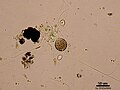
Suctoria is a subclass of protozoa within the class Ciliophora. Suctorians are characterized by their unique feeding mechanism; unlike other ciliates that use cilia to gather food particles throughout their life, suctorians, after an initial ciliated larval stage, transform into sessile adults that lack cilia but possess specialized tentacles used for feeding. These tentacles attach to prey, typically other protozoans, and draw out the contents of the prey cell through a process known as phagocytosis.
Characteristics
Suctorians exhibit a fascinating life cycle that begins with a free-swimming, ciliated larval stage known as the swarmer. During this stage, the organism disperses to find a suitable substrate to attach to. Upon attachment, the suctorian undergoes a transformation where it loses its cilia and develops feeding tentacles. These tentacles are not only pivotal for feeding but also for anchoring the organism to the substrate.
The body of a suctorian is typically globular or irregular in shape, and the number and arrangement of tentacles can vary significantly among different species. The tentacles are equipped with specialized structures called haptocysts at their tips, which are used to pierce the prey's cell membrane and establish a feeding tube through which the prey's cytoplasm is ingested.
Reproduction
Suctorians reproduce asexually through a process known as budding. In this process, a new individual, or bud, forms from the body of the parent. This bud develops its own tentacles before detaching to lead an independent life. Some species of suctorians can also reproduce sexually, a less common mode of reproduction where gametes are produced and fuse to form a zygote, which then develops into a new individual.
Ecology
Suctorians are found in a variety of aquatic environments, including freshwater and marine habitats. They play a significant role in the microbial food web by preying on other protozoans and, in turn, being preyed upon by larger organisms. Their presence and abundance can be indicative of the health and stability of aquatic ecosystems.
Classification
The classification of suctorians within the broader group of ciliates has been subject to revision as new molecular and genetic data become available. They are currently placed in the subclass Suctoria within the class Ciliophora, but this classification may evolve with further research.
Research and Importance
Suctorians are of interest to researchers for several reasons. Their unique feeding mechanism and life cycle provide insights into protozoan evolution and ecology. Additionally, studying suctorians can help scientists understand the dynamics of aquatic ecosystems and the role of protozoans in microbial food webs.
See Also

-
 Suctoria
 -
 Suctoria
 -
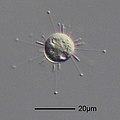 Podophyra sp. (Suctoria) - 160x


_-_160x_(13895748593).jpg)
Ad. Transform your health with W8MD Weight Loss, Sleep & MedSpa

Tired of being overweight?
Get started with evidence based, physician-supervised
affordable GLP-1 weight loss injections
Now available in New York City and Philadelphia:
- Semaglutide starting from $59.99/week and up
- Tirzepatide starting from $69.99/week and up (dose dependent)
✔ Evidence-based medical weight loss ✔ Insurance-friendly visits available ✔ Same-week appointments, evenings & weekends
Learn more:
Start your transformation today with W8MD weight loss centers.
|
WikiMD Medical Encyclopedia |
Medical Disclaimer: WikiMD is for informational purposes only and is not a substitute for professional medical advice. Content may be inaccurate or outdated and should not be used for diagnosis or treatment. Always consult your healthcare provider for medical decisions. Verify information with trusted sources such as CDC.gov and NIH.gov. By using this site, you agree that WikiMD is not liable for any outcomes related to its content. See full disclaimer.
Credits:Most images are courtesy of Wikimedia commons, and templates, categories Wikipedia, licensed under CC BY SA or similar.
Translate this page: - East Asian
中文,
日本,
한국어,
South Asian
हिन्दी,
தமிழ்,
తెలుగు,
Urdu,
ಕನ್ನಡ,
Southeast Asian
Indonesian,
Vietnamese,
Thai,
မြန်မာဘာသာ,
বাংলা
European
español,
Deutsch,
français,
Greek,
português do Brasil,
polski,
română,
русский,
Nederlands,
norsk,
svenska,
suomi,
Italian
Middle Eastern & African
عربى,
Turkish,
Persian,
Hebrew,
Afrikaans,
isiZulu,
Kiswahili,
Other
Bulgarian,
Hungarian,
Czech,
Swedish,
മലയാളം,
मराठी,
ਪੰਜਾਬੀ,
ગુજરાતી,
Portuguese,
Ukrainian
