Curing (chemistry)
Curing (chemistry)
Curing (chemistry) is a chemical process employed in polymer chemistry and process engineering that produces the toughening or hardening of a polymer material by cross-linking of polymer chains. This is brought about by chemical additives, ultraviolet radiation, electron beam or heat.
Process
Curing can be initiated by heat, humidity, radiation, electron beams, or chemical additives. The process involves the formation of long-chain polymer chains. These polymers are then cross-linked to create a three-dimensional network of connected molecules. The resulting material is resistant to deformation and has improved physical properties.
Applications
Curing processes are widely used in the production of composite materials, adhesives, paints, varnishes, and rubber. In the case of thermosetting polymers, curing is an irreversible process as it sets the polymer into a solid shape that cannot be re-melted or reformed.
Curing Agents
Curing agents are substances that promote or control the curing process by taking part in it. The choice of curing agent can significantly affect the physical properties of the cured polymer, the curing rate, and the nature of the chemical reactions that take place.
See Also


-
 Vernetzte Epoxidharze
 -
 Vulcanization of POLYIsoprene
 -
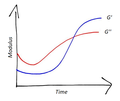 Moduli vs Time curing reaction


Ad. Transform your life with W8MD's
GLP-1 weight loss injections special from $29.99 with insurance
|
WikiMD Medical Encyclopedia |
Medical Disclaimer: WikiMD is for informational purposes only and is not a substitute for professional medical advice. Content may be inaccurate or outdated and should not be used for diagnosis or treatment. Always consult your healthcare provider for medical decisions. Verify information with trusted sources such as CDC.gov and NIH.gov. By using this site, you agree that WikiMD is not liable for any outcomes related to its content. See full disclaimer.
Credits:Most images are courtesy of Wikimedia commons, and templates, categories Wikipedia, licensed under CC BY SA or similar.
Translate this page: - East Asian
中文,
日本,
한국어,
South Asian
हिन्दी,
தமிழ்,
తెలుగు,
Urdu,
ಕನ್ನಡ,
Southeast Asian
Indonesian,
Vietnamese,
Thai,
မြန်မာဘာသာ,
বাংলা
European
español,
Deutsch,
français,
Greek,
português do Brasil,
polski,
română,
русский,
Nederlands,
norsk,
svenska,
suomi,
Italian
Middle Eastern & African
عربى,
Turkish,
Persian,
Hebrew,
Afrikaans,
isiZulu,
Kiswahili,
Other
Bulgarian,
Hungarian,
Czech,
Swedish,
മലയാളം,
मराठी,
ਪੰਜਾਬੀ,
ગુજરાતી,
Portuguese,
Ukrainian
