Marasmius oreades
Marasmius oreades, also known as the fairy ring mushroom or Scotch bonnet, is a common species of mushroom found in grasslands, meadows, and other grassy areas in Europe and North America. It is known for its tendency to grow in a fairy ring formation.
Description
The cap of Marasmius oreades is 2–5 cm in diameter, bell-shaped to convex, and becomes flatter with a slight umbo with age. The cap surface is smooth and has a pale buff or cream color, sometimes with a pinkish hue. The gills are widely spaced, and the stem is tough and pliable.
Distribution and habitat
Marasmius oreades is widely distributed in the Northern Hemisphere including parts of North America, Europe, and Asia. It is commonly found in grassy areas such as lawns, meadows, and pastures. The species is known for its ability to form fairy rings, a phenomenon where the mushrooms grow in a circular pattern.
Edibility
Marasmius oreades is an edible mushroom. It has a pleasant taste and aroma, which has been described as resembling fresh fruit. It is used in various culinary dishes, including soups, stews, and sauces. However, as with all wild mushrooms, it should only be consumed if positively identified by an expert.
Cultivation
While Marasmius oreades is not typically cultivated on a commercial scale, it can be grown at home with the right conditions. The mushroom prefers a warm, moist environment and a substrate of grass or straw.
See also
References
<references />
This mushroom-related article is a stub. You can help WikiMD by expanding it.
-
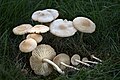 Marasmius oreades in Michigan
 -
 Marasmius oreades on black background
 -
 Marasmius oreades string


Ad. Transform your life with W8MD's
GLP-1 weight loss injections special from $29.99 with insurance
|
WikiMD Medical Encyclopedia |
Medical Disclaimer: WikiMD is for informational purposes only and is not a substitute for professional medical advice. Content may be inaccurate or outdated and should not be used for diagnosis or treatment. Always consult your healthcare provider for medical decisions. Verify information with trusted sources such as CDC.gov and NIH.gov. By using this site, you agree that WikiMD is not liable for any outcomes related to its content. See full disclaimer.
Credits:Most images are courtesy of Wikimedia commons, and templates, categories Wikipedia, licensed under CC BY SA or similar.
Translate this page: - East Asian
中文,
日本,
한국어,
South Asian
हिन्दी,
தமிழ்,
తెలుగు,
Urdu,
ಕನ್ನಡ,
Southeast Asian
Indonesian,
Vietnamese,
Thai,
မြန်မာဘာသာ,
বাংলা
European
español,
Deutsch,
français,
Greek,
português do Brasil,
polski,
română,
русский,
Nederlands,
norsk,
svenska,
suomi,
Italian
Middle Eastern & African
عربى,
Turkish,
Persian,
Hebrew,
Afrikaans,
isiZulu,
Kiswahili,
Other
Bulgarian,
Hungarian,
Czech,
Swedish,
മലയാളം,
मराठी,
ਪੰਜਾਬੀ,
ગુજરાતી,
Portuguese,
Ukrainian
