Chromosomal inversion
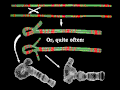
Chromosomal inversion is a type of chromosomal abnormality in which a segment of a chromosome is reversed end to end. This occurs when a single chromosome undergoes breakage and rearrangement within itself. Inversions are of two types: pericentric and paracentric.
Pericentric inversion
A pericentric inversion involves the centromere of the chromosome. In this type of inversion, the inverted segment includes the centromere and hence both arms of the chromosome. This can lead to an unbalanced genetic rearrangement during meiosis, which can result in offspring with genetic disorders.
Paracentric inversion
A paracentric inversion does not involve the centromere. The inverted segment occurs in one arm of the chromosome only. This type of inversion can also lead to unbalanced genetic rearrangement during meiosis, potentially resulting in genetic disorders in offspring.
Effects of chromosomal inversion
The effects of chromosomal inversion can vary greatly. In some cases, the inversion does not disrupt the genetic information and the individual exhibits no physical or health effects. However, if the inversion disrupts vital genes, it can result in significant health and developmental problems.
Inversion and evolution
Chromosomal inversion has been implicated in the process of evolution. It can lead to the formation of new species through a process known as speciation. This is because inversions can suppress genetic recombination, allowing different genetic variants to evolve independently.
See also

-
 Chromosomal inversion
 -
 Chromosomal inversion
 -
 Chromosomal inversion
 -
 Chromosomal inversion


Ad. Transform your life with W8MD's
GLP-1 weight loss injections special from $29.99 with insurance
|
WikiMD Medical Encyclopedia |
Medical Disclaimer: WikiMD is for informational purposes only and is not a substitute for professional medical advice. Content may be inaccurate or outdated and should not be used for diagnosis or treatment. Always consult your healthcare provider for medical decisions. Verify information with trusted sources such as CDC.gov and NIH.gov. By using this site, you agree that WikiMD is not liable for any outcomes related to its content. See full disclaimer.
Credits:Most images are courtesy of Wikimedia commons, and templates, categories Wikipedia, licensed under CC BY SA or similar.
Translate this page: - East Asian
中文,
日本,
한국어,
South Asian
हिन्दी,
தமிழ்,
తెలుగు,
Urdu,
ಕನ್ನಡ,
Southeast Asian
Indonesian,
Vietnamese,
Thai,
မြန်မာဘာသာ,
বাংলা
European
español,
Deutsch,
français,
Greek,
português do Brasil,
polski,
română,
русский,
Nederlands,
norsk,
svenska,
suomi,
Italian
Middle Eastern & African
عربى,
Turkish,
Persian,
Hebrew,
Afrikaans,
isiZulu,
Kiswahili,
Other
Bulgarian,
Hungarian,
Czech,
Swedish,
മലയാളം,
मराठी,
ਪੰਜਾਬੀ,
ગુજરાતી,
Portuguese,
Ukrainian
