Rope bondage
Rope bondage is a form of bondage where rope is used primarily as a means of sexual restraint. Although it can be used in a BDSM context, it is not exclusively so and can be employed for aesthetic or other purposes.
History
The history of rope bondage is intertwined with the history of rope itself. Rope has been used for centuries as a tool for restraint and control. In the context of bondage, it has been used in various cultures and eras, from ancient Greece and Rome to the Japanese art of Shibari.
Techniques
There are many techniques in rope bondage, including the single column tie, double column tie, chest harness, and Shibari. These techniques vary in complexity and the level of risk involved.
Single Column Tie
The single column tie is a basic technique where a single limb is bound. It is often the starting point for more complex bondage ties.
Double Column Tie
The double column tie is a technique where two limbs are bound together. This can be used in a variety of positions and scenarios.
Chest Harness
The chest harness is a more complex technique that involves binding the torso. This can be used for aesthetic purposes, or to restrict movement and create a sense of confinement.
Shibari
Shibari is a traditional Japanese form of rope bondage. It is characterized by its intricate and beautiful patterns, and often involves multiple ropes and complex knots.
Safety
Safety is a crucial aspect of rope bondage. It is important to have a good understanding of anatomy and physiology, as well as the properties of the rope being used. Risks include nerve damage, circulation problems, and in extreme cases, asphyxiation. It is recommended to have safety scissors on hand in case the rope needs to be cut quickly.
See Also
-
 RopeMarks at BoundCon 2008
 -
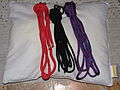 Bondage rope
 -
 Paris Cabaret at Casino Helsinki
 -
 Andreaskreuz with Model Monique
 -
 Bondage endurance challenge at BoundCon 2013
 -
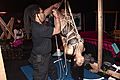 Exxxotica AC 2013
 -
 Hogtie with handle


.jpg)

Ad. Transform your life with W8MD's
GLP-1 weight loss injections special from $29.99 with insurance
|
WikiMD Medical Encyclopedia |
Medical Disclaimer: WikiMD is for informational purposes only and is not a substitute for professional medical advice. Content may be inaccurate or outdated and should not be used for diagnosis or treatment. Always consult your healthcare provider for medical decisions. Verify information with trusted sources such as CDC.gov and NIH.gov. By using this site, you agree that WikiMD is not liable for any outcomes related to its content. See full disclaimer.
Credits:Most images are courtesy of Wikimedia commons, and templates, categories Wikipedia, licensed under CC BY SA or similar.
Translate this page: - East Asian
中文,
日本,
한국어,
South Asian
हिन्दी,
தமிழ்,
తెలుగు,
Urdu,
ಕನ್ನಡ,
Southeast Asian
Indonesian,
Vietnamese,
Thai,
မြန်မာဘာသာ,
বাংলা
European
español,
Deutsch,
français,
Greek,
português do Brasil,
polski,
română,
русский,
Nederlands,
norsk,
svenska,
suomi,
Italian
Middle Eastern & African
عربى,
Turkish,
Persian,
Hebrew,
Afrikaans,
isiZulu,
Kiswahili,
Other
Bulgarian,
Hungarian,
Czech,
Swedish,
മലയാളം,
मराठी,
ਪੰਜਾਬੀ,
ગુજરાતી,
Portuguese,
Ukrainian

