Borosilicate glass
Borosilicate glass is a type of glass with silicon dioxide and boron trioxide as the main glass-forming constituents. Borosilicate glasses are known for having very low coefficient of thermal expansion (~3 × 10⁻⁶ K−1 at 20 °C), making them resistant to thermal shock, more so than any other common glass.
History
In the late 19th century, Otto Schott, a German glassmaker, developed borosilicate glass, which was marketed under the brand name Duran in 1893. After Corning Incorporated refined the process, the product was sold under the brand name Pyrex in 1915.
Composition
Borosilicate glass is created by combining and melting boron, silicon, aluminum, sodium, and potassium at approximately 3000 degrees Fahrenheit. The resultant glass contains about 80% silica, 13% boron trioxide, 4% sodium oxide, and 2-3% aluminum oxide.
Properties
Borosilicate glass is highly resistant to thermal shock due to its low thermal expansion coefficient. This makes it ideal for use in certain environments where rapid temperature changes occur. It also has excellent chemical resistance, high radiation resistance, and good mechanical strength.
Uses
Borosilicate glass is used in a wide range of applications due to its durability and resistance to heat and chemicals. It is commonly used in laboratory glassware, cookware, lighting, and in high-end audio equipment. It is also used in the production of glass fiber for fiber optics and in the aerospace industry.
See also
References
<references />

-
 Borosilicate glass guitar slide
 -
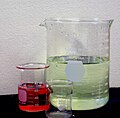 Borosilicate glass beakers
 -
 Borosilicate glass Arcopal


Ad. Transform your life with W8MD's
GLP-1 weight loss injections special from $29.99 with insurance
|
WikiMD Medical Encyclopedia |
Medical Disclaimer: WikiMD is for informational purposes only and is not a substitute for professional medical advice. Content may be inaccurate or outdated and should not be used for diagnosis or treatment. Always consult your healthcare provider for medical decisions. Verify information with trusted sources such as CDC.gov and NIH.gov. By using this site, you agree that WikiMD is not liable for any outcomes related to its content. See full disclaimer.
Credits:Most images are courtesy of Wikimedia commons, and templates, categories Wikipedia, licensed under CC BY SA or similar.
Translate this page: - East Asian
中文,
日本,
한국어,
South Asian
हिन्दी,
தமிழ்,
తెలుగు,
Urdu,
ಕನ್ನಡ,
Southeast Asian
Indonesian,
Vietnamese,
Thai,
မြန်မာဘာသာ,
বাংলা
European
español,
Deutsch,
français,
Greek,
português do Brasil,
polski,
română,
русский,
Nederlands,
norsk,
svenska,
suomi,
Italian
Middle Eastern & African
عربى,
Turkish,
Persian,
Hebrew,
Afrikaans,
isiZulu,
Kiswahili,
Other
Bulgarian,
Hungarian,
Czech,
Swedish,
മലയാളം,
मराठी,
ਪੰਜਾਬੀ,
ગુજરાતી,
Portuguese,
Ukrainian
