Soppressata
Soppressata is a type of Italian salami. There are two principal types of soppressata: a cured dry sausage typical of Basilicata, Apulia, and Calabria, and a very different uncured salami, native to Tuscany and Liguria.
History
The tradition of making soppressata can be traced back to the ancient Romans. It was a way to preserve meat for long periods of time. The name "soppressata" comes from the Italian word "soppressare", which means "to press down". This refers to the process of pressing the meat to remove air and moisture, which helps to preserve it.
Production
Soppressata is made from the finest quality pork. The meat is carefully selected, cut into large pieces, and seasoned with natural flavors such as salt, pepper, and sometimes hot pepper or fennel. The meat is then stuffed into a natural casing, pressed, and left to cure for several weeks. The pressing gives the salami its characteristic flattened shape.
Varieties
There are many varieties of soppressata, each with its own unique flavor profile. The most common types are Soppressata di Basilicata, Soppressata di Calabria, and Soppressata Toscana. Each variety is named after the region in Italy where it is produced, and each region has its own traditional recipe and method of production.
Serving
Soppressata can be served in a variety of ways. It is often sliced thin and served as part of an antipasto platter, along with other cured meats, cheeses, and olives. It can also be used in sandwiches, or cooked in pasta dishes or pizza.
See also
| Italian cuisine |
|---|
|
|

-
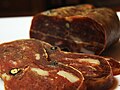 Sliced soppressata
 -
Soppressata
-
Soppressata
-
Soppressata
-
 Polenta with soppressata and mushrooms


Ad. Transform your life with W8MD's
GLP-1 weight loss injections special from $29.99 with insurance
|
WikiMD Medical Encyclopedia |
Medical Disclaimer: WikiMD is for informational purposes only and is not a substitute for professional medical advice. Content may be inaccurate or outdated and should not be used for diagnosis or treatment. Always consult your healthcare provider for medical decisions. Verify information with trusted sources such as CDC.gov and NIH.gov. By using this site, you agree that WikiMD is not liable for any outcomes related to its content. See full disclaimer.
Credits:Most images are courtesy of Wikimedia commons, and templates, categories Wikipedia, licensed under CC BY SA or similar.
Translate this page: - East Asian
中文,
日本,
한국어,
South Asian
हिन्दी,
தமிழ்,
తెలుగు,
Urdu,
ಕನ್ನಡ,
Southeast Asian
Indonesian,
Vietnamese,
Thai,
မြန်မာဘာသာ,
বাংলা
European
español,
Deutsch,
français,
Greek,
português do Brasil,
polski,
română,
русский,
Nederlands,
norsk,
svenska,
suomi,
Italian
Middle Eastern & African
عربى,
Turkish,
Persian,
Hebrew,
Afrikaans,
isiZulu,
Kiswahili,
Other
Bulgarian,
Hungarian,
Czech,
Swedish,
മലയാളം,
मराठी,
ਪੰਜਾਬੀ,
ગુજરાતી,
Portuguese,
Ukrainian


