Stroboscope
Stroboscope
A Stroboscope also known as a strobe light, is an instrument used to make a cyclically moving object appear to be slow-moving, or stationary. It consists of either a disc with slots or holes or a lamp such as a neon lamp or a LED with a variable frequency.
History
The stroboscope was invented by Simon von Stampfer in Austria, Joseph Plateau in Belgium and Michael Faraday in Britain in the 1830s. The modern version of the instrument was developed by Harold Eugene Edgerton in 1931.
Principle of operation
The principle of operation of a stroboscope is to illuminate the object to be studied with a light that is flashing at the same frequency as the object is moving. If the object is moving at the same frequency as the light is flashing, the object will appear to be stationary.
Applications
Stroboscopes have a wide range of applications in various fields. They are used in medicine, industry, and entertainment. In medicine, they are used to study the movement of the vocal cords. In industry, they are used to measure the speed of rotating equipment. In entertainment, they are used to create visual effects in discos and other entertainment venues.
See also
References
<references />
 | This medical article is a stub. You can help WikiMD by expanding the page. |
-
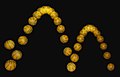 Bouncing ball captured with a stroboscope
 -
 Strobe effect animation
 -
 1540 Strobolume by General Radio Corporation - separate control box and strobe on tripod
 -
 Close-up of the control box of the 1540 Strobolume
 -
 Stroboscope for a phonograph at 33 RPM


.JPG)

Medical Disclaimer: WikiMD is for informational purposes only and is not a substitute for professional medical advice. Content may be inaccurate or outdated and should not be used for diagnosis or treatment. Always consult your healthcare provider for medical decisions. Verify information with trusted sources such as CDC.gov and NIH.gov. By using this site, you agree that WikiMD is not liable for any outcomes related to its content. See full disclaimer.
Credits:Most images are courtesy of Wikimedia commons, and templates, categories Wikipedia, licensed under CC BY SA or similar.
Translate this page: - East Asian
中文,
日本,
한국어,
South Asian
हिन्दी,
தமிழ்,
తెలుగు,
Urdu,
ಕನ್ನಡ,
Southeast Asian
Indonesian,
Vietnamese,
Thai,
မြန်မာဘာသာ,
বাংলা
European
español,
Deutsch,
français,
Greek,
português do Brasil,
polski,
română,
русский,
Nederlands,
norsk,
svenska,
suomi,
Italian
Middle Eastern & African
عربى,
Turkish,
Persian,
Hebrew,
Afrikaans,
isiZulu,
Kiswahili,
Other
Bulgarian,
Hungarian,
Czech,
Swedish,
മലയാളം,
मराठी,
ਪੰਜਾਬੀ,
ગુજરાતી,
Portuguese,
Ukrainian
