HeLa
HeLa is a cell type in an immortal cell line used in scientific research. It is the oldest and most commonly used human cell line. The line was derived from cervical cancer cells taken on February 8, 1951, from Henrietta Lacks, a patient who died of cancer on October 4, 1951. The cell line was found to be remarkably durable and prolific, which warrants its extensive use in scientific research.
History
The cells from Henrietta Lacks were taken without her knowledge or consent, which was common practice at the time. Her family was not made aware of the line's existence until 1975. Since the cells' mass production and commercialization, Lacks's family have never received any financial compensation or recognition for their contribution.
Characteristics
HeLa cells are notable for their ability to reproduce indefinitely under specific conditions. This characteristic makes them a good model for studying the effects of various variables on cell growth and metabolism. They have been used in research to develop the polio vaccine, study cancer, and advance in vitro fertilization, cloning, and gene mapping.
Ethical Issues
The use of HeLa cells has raised ethical and legal issues, including informed consent and privacy. It has prompted changes in U.S. law and changes in practices regarding informed consent and compensation in genetic research.
In Popular Culture
The story of Henrietta Lacks and HeLa cells was popularized by Rebecca Skloot's 2010 book, The Immortal Life of Henrietta Lacks, and a subsequent HBO film of the same name starring Oprah Winfrey.
See Also
References
<references />
 | |
|---|---|
 |
 |
HeLa
-
 HeLa-IV
 -
 HeLa-I
 -
 HeLa cells stained with antibody to actin (green), vimentin (red) and DNA (blue)
 -
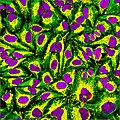 HeLa-Tubulin-HSP60-Fibrillarin-DNA
 -
 Henrietta Lacks statue, Bristol, RHS
 -
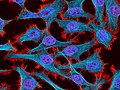 HeLa-II
 -
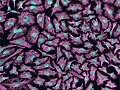 HeLa-III
 -
 HeLa-V
 -
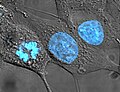 HeLa cells stained with Hoechst 33258
 -
 Ki67-Tubulin-2
 -
 Nuclear envelope of one cancerous HeLa cell
 -
 Plasma Membrane and Nuclear Envelope


_,_vimentin_(red)_and_DNA_(blue).jpg)


Ad. Transform your life with W8MD's
GLP-1 weight loss injections special from $29.99 with insurance
|
WikiMD Medical Encyclopedia |
Medical Disclaimer: WikiMD is for informational purposes only and is not a substitute for professional medical advice. Content may be inaccurate or outdated and should not be used for diagnosis or treatment. Always consult your healthcare provider for medical decisions. Verify information with trusted sources such as CDC.gov and NIH.gov. By using this site, you agree that WikiMD is not liable for any outcomes related to its content. See full disclaimer.
Credits:Most images are courtesy of Wikimedia commons, and templates, categories Wikipedia, licensed under CC BY SA or similar.
Translate this page: - East Asian
中文,
日本,
한국어,
South Asian
हिन्दी,
தமிழ்,
తెలుగు,
Urdu,
ಕನ್ನಡ,
Southeast Asian
Indonesian,
Vietnamese,
Thai,
မြန်မာဘာသာ,
বাংলা
European
español,
Deutsch,
français,
Greek,
português do Brasil,
polski,
română,
русский,
Nederlands,
norsk,
svenska,
suomi,
Italian
Middle Eastern & African
عربى,
Turkish,
Persian,
Hebrew,
Afrikaans,
isiZulu,
Kiswahili,
Other
Bulgarian,
Hungarian,
Czech,
Swedish,
മലയാളം,
मराठी,
ਪੰਜਾਬੀ,
ગુજરાતી,
Portuguese,
Ukrainian
