Ugali
Ugali
Ugali is a type of maize porridge made in Africa. It is also known as sima, sembe, or posho. It is a staple food in many African countries, including Kenya, Tanzania, Uganda, and Malawi. Ugali is usually made from maize flour (cornmeal) and water, and it is cooked to a dough-like consistency.
Preparation
Ugali is prepared by mixing maize flour with water and cooking it over a fire or stove. The mixture is stirred continuously until it thickens and becomes smooth. The consistency of ugali can vary from soft to firm, depending on personal preference and regional variations. It is typically served as a side dish and eaten with the hands.
Cultural Significance
Ugali is more than just a food; it is a cultural symbol in many African communities. It is often served at communal gatherings and is considered a comfort food. In some cultures, ugali is used to scoop up other foods, such as vegetables, meat, or sauces.
Variations
While ugali is primarily made from maize flour, variations exist depending on the region. In some areas, it is made with millet or sorghum flour. In West Africa, a similar dish known as tuo zaafi is made with millet or sorghum.
Related Dishes
Ugali is similar to other porridge-like dishes found around the world. In South Africa, a similar dish called pap is made, while in Zimbabwe, it is known as sadza. In Zambia, it is referred to as nshima.
Related Pages
References
Gallery
-
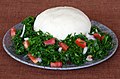 Ugali served with sukuma wiki
 -
 Friends in Malawi eating nsima, ndiwo, and masamba
 -
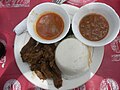 Ugali with beef and sauce
 -
 Ugali served at night
 -
 Tuo zaafi, a similar dish
 -
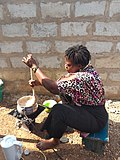 A woman stirring tuo zaafi
 -
 Tuo zaafi with ayoyo soup
 -
 Eating ugali in Kenya
 -
 Nsima with relishes
 -
 Uphuthu and skop meal
 -
 People cooking pap
 -
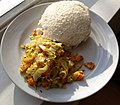 Ugali with cabbage
 -
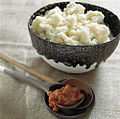 Phutu, a similar dish
 -
 Goat offal served with ugali
 -
 Yawo food staples: ugali and usipa


_(Phaleche)_7.jpg)


Ad. Transform your life with W8MD's
GLP-1 weight loss injections special from $29.99 with insurance
|
WikiMD Medical Encyclopedia |
Medical Disclaimer: WikiMD is for informational purposes only and is not a substitute for professional medical advice. Content may be inaccurate or outdated and should not be used for diagnosis or treatment. Always consult your healthcare provider for medical decisions. Verify information with trusted sources such as CDC.gov and NIH.gov. By using this site, you agree that WikiMD is not liable for any outcomes related to its content. See full disclaimer.
Credits:Most images are courtesy of Wikimedia commons, and templates, categories Wikipedia, licensed under CC BY SA or similar.
Translate this page: - East Asian
中文,
日本,
한국어,
South Asian
हिन्दी,
தமிழ்,
తెలుగు,
Urdu,
ಕನ್ನಡ,
Southeast Asian
Indonesian,
Vietnamese,
Thai,
မြန်မာဘာသာ,
বাংলা
European
español,
Deutsch,
français,
Greek,
português do Brasil,
polski,
română,
русский,
Nederlands,
norsk,
svenska,
suomi,
Italian
Middle Eastern & African
عربى,
Turkish,
Persian,
Hebrew,
Afrikaans,
isiZulu,
Kiswahili,
Other
Bulgarian,
Hungarian,
Czech,
Swedish,
മലയാളം,
मराठी,
ਪੰਜਾਬੀ,
ગુજરાતી,
Portuguese,
Ukrainian
