Lower segment Caesarean section: Difference between revisions
CSV import |
CSV import |
||
| Line 1: | Line 1: | ||
{{SI}} | |||
{{Infobox medical condition | |||
| name = Lower segment Caesarean section | |||
| image = [[File:Pfannenstiel2.JPG|250px]] | |||
| alt = | |||
| caption = Pfannenstiel incision used in lower segment Caesarean section | |||
| field = [[Obstetrics]] | |||
| synonyms = | |||
| symptoms = | |||
| complications = [[Infection]], [[hemorrhage]], [[blood clots]], [[injury to organs]] | |||
| onset = | |||
| duration = | |||
| types = | |||
| causes = | |||
| risks = [[Previous Caesarean section]], [[placenta previa]], [[fetal distress]] | |||
| diagnosis = | |||
| differential = | |||
| prevention = | |||
| treatment = Surgical procedure | |||
| medication = [[Antibiotics]], [[anesthesia]] | |||
| prognosis = Generally good with proper care | |||
| frequency = | |||
| deaths = | |||
}} | |||
'''Lower Segment Caesarean Section''' (LSCS) is a type of [[Caesarean section]] (C-section) which is the most common method of delivering babies when vaginal delivery would put the baby or mother at risk. This surgical procedure involves making an incision in the lower segment of the [[uterus]] to deliver the baby. The lower segment Caesarean section is preferred over the classical Caesarean section due to its lower risk of complications and quicker healing time. | '''Lower Segment Caesarean Section''' (LSCS) is a type of [[Caesarean section]] (C-section) which is the most common method of delivering babies when vaginal delivery would put the baby or mother at risk. This surgical procedure involves making an incision in the lower segment of the [[uterus]] to deliver the baby. The lower segment Caesarean section is preferred over the classical Caesarean section due to its lower risk of complications and quicker healing time. | ||
==Indications== | ==Indications== | ||
The indications for a Lower Segment Caesarean Section include but are not limited to: | The indications for a Lower Segment Caesarean Section include but are not limited to: | ||
| Line 9: | Line 32: | ||
* Previous Caesarean sections: Depending on the number and type of previous C-sections, a repeat procedure may be recommended. | * Previous Caesarean sections: Depending on the number and type of previous C-sections, a repeat procedure may be recommended. | ||
* Certain maternal medical conditions, such as active genital herpes or certain types of heart disease. | * Certain maternal medical conditions, such as active genital herpes or certain types of heart disease. | ||
==Procedure== | ==Procedure== | ||
The procedure for a Lower Segment Caesarean Section typically involves: | The procedure for a Lower Segment Caesarean Section typically involves: | ||
| Line 17: | Line 39: | ||
# Delivering the baby through the uterine incision. | # Delivering the baby through the uterine incision. | ||
# Removing the placenta and closing the incisions with sutures. | # Removing the placenta and closing the incisions with sutures. | ||
==Advantages== | ==Advantages== | ||
The advantages of a Lower Segment Caesarean Section include: | The advantages of a Lower Segment Caesarean Section include: | ||
| Line 24: | Line 45: | ||
* Reduced risk of uterine rupture in future pregnancies. | * Reduced risk of uterine rupture in future pregnancies. | ||
* The horizontal incision in the lower segment of the uterus is less likely to tear in future pregnancies or labors. | * The horizontal incision in the lower segment of the uterus is less likely to tear in future pregnancies or labors. | ||
==Risks and Complications== | ==Risks and Complications== | ||
While a Lower Segment Caesarean Section is generally safe, it is not without risks. Complications can include: | While a Lower Segment Caesarean Section is generally safe, it is not without risks. Complications can include: | ||
| Line 32: | Line 52: | ||
* Increased risk of respiratory problems for the baby. | * Increased risk of respiratory problems for the baby. | ||
* Potential for increased recovery time and pain compared to vaginal delivery. | * Potential for increased recovery time and pain compared to vaginal delivery. | ||
==Recovery== | ==Recovery== | ||
Recovery from a Lower Segment Caesarean Section involves: | Recovery from a Lower Segment Caesarean Section involves: | ||
| Line 39: | Line 58: | ||
* Monitoring the incision site for signs of infection. | * Monitoring the incision site for signs of infection. | ||
* Gradual return to normal activities as advised by the healthcare provider. | * Gradual return to normal activities as advised by the healthcare provider. | ||
==Gallery== | |||
== | |||
<gallery> | <gallery> | ||
File:C-sec_suture.jpg|Suturing after C-section | File:C-sec_suture.jpg|Suturing after C-section | ||
File:Cesareo.svg|Diagram of Cesarean section | File:Cesareo.svg|Diagram of Cesarean section | ||
| Line 57: | Line 69: | ||
File:Suturing_uterus.JPG|Suturing the uterus | File:Suturing_uterus.JPG|Suturing the uterus | ||
</gallery> | </gallery> | ||
==Conclusion== | |||
Lower Segment Caesarean Section is a common and generally safe method for delivering babies when vaginal delivery is not advisable. It has several advantages over the classical Caesarean section, including a lower risk of complications and a quicker recovery period. However, like any surgical procedure, it carries risks and requires a period of recovery. | |||
[[Category:Obstetrics]] | |||
[[Category:Surgical procedures]] | |||
{{surgery-stub}} | |||
Latest revision as of 03:17, 6 April 2025

Editor-In-Chief: Prab R Tumpati, MD
Obesity, Sleep & Internal medicine
Founder, WikiMD Wellnesspedia &
W8MD medical weight loss NYC and sleep center NYC
| Lower segment Caesarean section | |
|---|---|

| |
| Synonyms | |
| Pronounce | N/A |
| Specialty | N/A |
| Symptoms | |
| Complications | Infection, hemorrhage, blood clots, injury to organs |
| Onset | |
| Duration | |
| Types | |
| Causes | |
| Risks | Previous Caesarean section, placenta previa, fetal distress |
| Diagnosis | |
| Differential diagnosis | |
| Prevention | |
| Treatment | Surgical procedure |
| Medication | Antibiotics, anesthesia |
| Prognosis | Generally good with proper care |
| Frequency | |
| Deaths | |
Lower Segment Caesarean Section (LSCS) is a type of Caesarean section (C-section) which is the most common method of delivering babies when vaginal delivery would put the baby or mother at risk. This surgical procedure involves making an incision in the lower segment of the uterus to deliver the baby. The lower segment Caesarean section is preferred over the classical Caesarean section due to its lower risk of complications and quicker healing time.
Indications[edit]
The indications for a Lower Segment Caesarean Section include but are not limited to:
- Placenta previa: A condition where the placenta covers the opening of the uterus.
- Fetal distress: Signs that the fetus is not well and may not be able to withstand the stress of vaginal delivery.
- Failure to progress in labor: When labor is not progressing as expected, either because the cervix is not dilating, the baby is not descending, or labor has stalled for other reasons.
- Breech presentation: When the baby is positioned to be delivered buttocks or feet first.
- Previous Caesarean sections: Depending on the number and type of previous C-sections, a repeat procedure may be recommended.
- Certain maternal medical conditions, such as active genital herpes or certain types of heart disease.
Procedure[edit]
The procedure for a Lower Segment Caesarean Section typically involves:
- Administration of anesthesia, which can be either regional (spinal or epidural) or general.
- Making a horizontal (bikini-line) incision just above the pubic hairline. This incision cuts through the skin and abdominal wall to reach the uterus.
- Making a second incision in the lower segment of the uterus. This incision is usually horizontal but can be vertical in certain circumstances.
- Delivering the baby through the uterine incision.
- Removing the placenta and closing the incisions with sutures.
Advantages[edit]
The advantages of a Lower Segment Caesarean Section include:
- Lower risk of bleeding and need for blood transfusion.
- Generally, a safer option for future pregnancies compared to the classical Caesarean section.
- Reduced risk of uterine rupture in future pregnancies.
- The horizontal incision in the lower segment of the uterus is less likely to tear in future pregnancies or labors.
Risks and Complications[edit]
While a Lower Segment Caesarean Section is generally safe, it is not without risks. Complications can include:
- Infection of the incision site or the uterus.
- Blood loss leading to anemia or the need for a blood transfusion.
- Injury to surrounding organs such as the bladder or intestines.
- Increased risk of respiratory problems for the baby.
- Potential for increased recovery time and pain compared to vaginal delivery.
Recovery[edit]
Recovery from a Lower Segment Caesarean Section involves:
- Pain management with medication.
- Avoiding strenuous activity and heavy lifting for several weeks.
- Monitoring the incision site for signs of infection.
- Gradual return to normal activities as advised by the healthcare provider.
Gallery[edit]
-
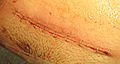 Suturing after C-section
 -
 Diagram of Cesarean section
 -
 Anterior wall of uterus
 -
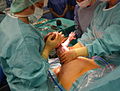 Pulling out the baby during C-section
 -
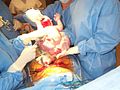 Lower segment Caesarean section
 -
 Newborn after Caesarean section
 -
 Caesarean section procedure
 -
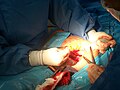 Suturing the uterus


Conclusion[edit]
Lower Segment Caesarean Section is a common and generally safe method for delivering babies when vaginal delivery is not advisable. It has several advantages over the classical Caesarean section, including a lower risk of complications and a quicker recovery period. However, like any surgical procedure, it carries risks and requires a period of recovery.


