Diffuse panbronchiolitis: Difference between revisions
CSV import |
CSV import |
||
| Line 1: | Line 1: | ||
{{SI}} | |||
{{Infobox medical condition | |||
| name = Diffuse panbronchiolitis | |||
| image = [[File:HRCT_scans_of_diffuse_panbronchiolitisCropped.jpg|250px]] | |||
| caption = High-resolution CT scan showing diffuse panbronchiolitis | |||
| field = [[Pulmonology]] | |||
| symptoms = [[Cough]], [[sputum]] production, [[dyspnea]] | |||
| complications = [[Bronchiectasis]], [[respiratory failure]] | |||
| onset = Typically in [[adulthood]] | |||
| duration = [[Chronic (medicine)|Chronic]] | |||
| causes = Unknown, possibly [[genetic]] and [[environmental factors]] | |||
| risks = [[Asian]] descent, particularly [[Japanese people|Japanese]] | |||
| diagnosis = [[High-resolution computed tomography|HRCT]], [[pulmonary function test]]s | |||
| differential = [[Bronchiectasis]], [[chronic obstructive pulmonary disease]] | |||
| treatment = [[Macrolide antibiotics]], [[corticosteroids]] | |||
| prognosis = Improved with treatment, but can lead to [[chronic respiratory failure]] | |||
| frequency = Rare, more common in [[East Asia]] | |||
}} | |||
'''Diffuse Panbronchiolitis''' (DPB) is a chronic inflammatory lung disease primarily affecting the [[bronchioles]]. It is characterized by chronic [[sinusitis]], [[productive cough]], and [[dyspnea]]. The condition is most commonly observed in individuals of [[East Asian]] descent, particularly in [[Japan]] and [[Korea]]. | '''Diffuse Panbronchiolitis''' (DPB) is a chronic inflammatory lung disease primarily affecting the [[bronchioles]]. It is characterized by chronic [[sinusitis]], [[productive cough]], and [[dyspnea]]. The condition is most commonly observed in individuals of [[East Asian]] descent, particularly in [[Japan]] and [[Korea]]. | ||
==Epidemiology== | ==Epidemiology== | ||
Diffuse Panbronchiolitis is predominantly seen in [[East Asian]] populations, with a higher prevalence in [[Japan]]. The disease is rare in other ethnic groups. The exact prevalence is not well-documented, but it is considered a rare disease outside of Asia. | Diffuse Panbronchiolitis is predominantly seen in [[East Asian]] populations, with a higher prevalence in [[Japan]]. The disease is rare in other ethnic groups. The exact prevalence is not well-documented, but it is considered a rare disease outside of Asia. | ||
==Etiology== | ==Etiology== | ||
The exact cause of Diffuse Panbronchiolitis is unknown. However, there is a strong association with certain [[genetic]] markers, particularly the [[HLA-B54]] antigen, suggesting a genetic predisposition. Environmental factors have not been clearly identified. | The exact cause of Diffuse Panbronchiolitis is unknown. However, there is a strong association with certain [[genetic]] markers, particularly the [[HLA-B54]] antigen, suggesting a genetic predisposition. Environmental factors have not been clearly identified. | ||
==Pathophysiology== | ==Pathophysiology== | ||
The disease is characterized by chronic inflammation of the [[bronchioles]], leading to the formation of [[lymphoid follicles]] and [[infiltration]] of [[neutrophils]] and [[lymphocytes]]. This results in obstruction of the small airways and impaired [[mucociliary clearance]], contributing to [[chronic infection]] and [[bronchiectasis]]. | The disease is characterized by chronic inflammation of the [[bronchioles]], leading to the formation of [[lymphoid follicles]] and [[infiltration]] of [[neutrophils]] and [[lymphocytes]]. This results in obstruction of the small airways and impaired [[mucociliary clearance]], contributing to [[chronic infection]] and [[bronchiectasis]]. | ||
==Clinical Features== | ==Clinical Features== | ||
Patients with Diffuse Panbronchiolitis typically present with: | Patients with Diffuse Panbronchiolitis typically present with: | ||
| Line 16: | Line 30: | ||
* [[Dyspnea]] on exertion | * [[Dyspnea]] on exertion | ||
* [[Chronic sinusitis]] | * [[Chronic sinusitis]] | ||
As the disease progresses, patients may develop [[respiratory failure]] and [[cor pulmonale]]. | As the disease progresses, patients may develop [[respiratory failure]] and [[cor pulmonale]]. | ||
==Diagnosis== | ==Diagnosis== | ||
The diagnosis of Diffuse Panbronchiolitis is based on clinical evaluation, imaging studies, and sometimes [[lung biopsy]]. | The diagnosis of Diffuse Panbronchiolitis is based on clinical evaluation, imaging studies, and sometimes [[lung biopsy]]. | ||
===Imaging=== | ===Imaging=== | ||
A [[CT scan]] of the chest typically shows diffuse [[nodular opacities]] and [[bronchiectasis]], particularly in the [[lower lobes]]. | A [[CT scan]] of the chest typically shows diffuse [[nodular opacities]] and [[bronchiectasis]], particularly in the [[lower lobes]]. | ||
===Biopsy=== | ===Biopsy=== | ||
A [[lung biopsy]] may be performed to confirm the diagnosis, showing characteristic [[histopathological]] features such as [[lymphoid hyperplasia]] and [[inflammatory cell infiltration]]. | A [[lung biopsy]] may be performed to confirm the diagnosis, showing characteristic [[histopathological]] features such as [[lymphoid hyperplasia]] and [[inflammatory cell infiltration]]. | ||
==Treatment== | ==Treatment== | ||
The mainstay of treatment for Diffuse Panbronchiolitis is long-term [[macrolide antibiotic]] therapy, such as [[erythromycin]] or [[clarithromycin]]. These antibiotics have anti-inflammatory properties that help reduce airway inflammation and improve symptoms. | The mainstay of treatment for Diffuse Panbronchiolitis is long-term [[macrolide antibiotic]] therapy, such as [[erythromycin]] or [[clarithromycin]]. These antibiotics have anti-inflammatory properties that help reduce airway inflammation and improve symptoms. | ||
==Prognosis== | ==Prognosis== | ||
With appropriate treatment, the prognosis for patients with Diffuse Panbronchiolitis has improved significantly. Long-term macrolide therapy can lead to stabilization or improvement of lung function and symptoms. | With appropriate treatment, the prognosis for patients with Diffuse Panbronchiolitis has improved significantly. Long-term macrolide therapy can lead to stabilization or improvement of lung function and symptoms. | ||
== Diffuse panbronchiolitis images == | |||
<gallery> | |||
File:HLA.svg|HLA | |||
File:HRCT scans of diffuse panbronchiolitis.jpg|Diffuse panbronchiolitis | |||
File:Erythromycin A.svg|Erythromycin A | |||
</gallery> | |||
==See Also== | ==See Also== | ||
* [[Bronchiectasis]] | * [[Bronchiectasis]] | ||
* [[Chronic obstructive pulmonary disease]] | * [[Chronic obstructive pulmonary disease]] | ||
* [[Interstitial lung disease]] | * [[Interstitial lung disease]] | ||
==External Links== | ==External Links== | ||
* [https://www.wikimd.com/wiki/Diffuse_panbronchiolitis WikiMD: Diffuse Panbronchiolitis] | * [https://www.wikimd.com/wiki/Diffuse_panbronchiolitis WikiMD: Diffuse Panbronchiolitis] | ||
{{Pulmonology}} | {{Pulmonology}} | ||
{{Respiratory diseases}} | {{Respiratory diseases}} | ||
[[Category:Respiratory diseases]] | [[Category:Respiratory diseases]] | ||
[[Category:Pulmonology]] | [[Category:Pulmonology]] | ||
[[Category:Rare diseases]] | [[Category:Rare diseases]] | ||
[[Category:Genetic disorders]] | [[Category:Genetic disorders]] | ||
Latest revision as of 18:16, 5 April 2025

Editor-In-Chief: Prab R Tumpati, MD
Obesity, Sleep & Internal medicine
Founder, WikiMD Wellnesspedia &
W8MD's medical weight loss NYC, sleep center NYC
Philadelphia medical weight loss and Philadelphia sleep clinics
| Diffuse panbronchiolitis | |
|---|---|

| |
| Synonyms | N/A |
| Pronounce | N/A |
| Specialty | N/A |
| Symptoms | Cough, sputum production, dyspnea |
| Complications | Bronchiectasis, respiratory failure |
| Onset | Typically in adulthood |
| Duration | Chronic |
| Types | N/A |
| Causes | Unknown, possibly genetic and environmental factors |
| Risks | Asian descent, particularly Japanese |
| Diagnosis | HRCT, pulmonary function tests |
| Differential diagnosis | Bronchiectasis, chronic obstructive pulmonary disease |
| Prevention | N/A |
| Treatment | Macrolide antibiotics, corticosteroids |
| Medication | N/A |
| Prognosis | Improved with treatment, but can lead to chronic respiratory failure |
| Frequency | Rare, more common in East Asia |
| Deaths | N/A |
Diffuse Panbronchiolitis (DPB) is a chronic inflammatory lung disease primarily affecting the bronchioles. It is characterized by chronic sinusitis, productive cough, and dyspnea. The condition is most commonly observed in individuals of East Asian descent, particularly in Japan and Korea.
Epidemiology[edit]
Diffuse Panbronchiolitis is predominantly seen in East Asian populations, with a higher prevalence in Japan. The disease is rare in other ethnic groups. The exact prevalence is not well-documented, but it is considered a rare disease outside of Asia.
Etiology[edit]
The exact cause of Diffuse Panbronchiolitis is unknown. However, there is a strong association with certain genetic markers, particularly the HLA-B54 antigen, suggesting a genetic predisposition. Environmental factors have not been clearly identified.
Pathophysiology[edit]
The disease is characterized by chronic inflammation of the bronchioles, leading to the formation of lymphoid follicles and infiltration of neutrophils and lymphocytes. This results in obstruction of the small airways and impaired mucociliary clearance, contributing to chronic infection and bronchiectasis.
Clinical Features[edit]
Patients with Diffuse Panbronchiolitis typically present with:
- Chronic cough
- Sputum production
- Dyspnea on exertion
- Chronic sinusitis
As the disease progresses, patients may develop respiratory failure and cor pulmonale.
Diagnosis[edit]
The diagnosis of Diffuse Panbronchiolitis is based on clinical evaluation, imaging studies, and sometimes lung biopsy.
Imaging[edit]
A CT scan of the chest typically shows diffuse nodular opacities and bronchiectasis, particularly in the lower lobes.
Biopsy[edit]
A lung biopsy may be performed to confirm the diagnosis, showing characteristic histopathological features such as lymphoid hyperplasia and inflammatory cell infiltration.
Treatment[edit]
The mainstay of treatment for Diffuse Panbronchiolitis is long-term macrolide antibiotic therapy, such as erythromycin or clarithromycin. These antibiotics have anti-inflammatory properties that help reduce airway inflammation and improve symptoms.
Prognosis[edit]
With appropriate treatment, the prognosis for patients with Diffuse Panbronchiolitis has improved significantly. Long-term macrolide therapy can lead to stabilization or improvement of lung function and symptoms.
Diffuse panbronchiolitis images[edit]
-
 HLA
HLA -
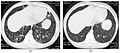 Diffuse panbronchiolitis
 -
 Erythromycin A


See Also[edit]
External Links[edit]
| Pulmonology topics | ||||||||||
|---|---|---|---|---|---|---|---|---|---|---|
This pulmonology-related article is a stub. You can help WikiMD by expanding it.
|
| Respiratory diseases | ||||||||||
|---|---|---|---|---|---|---|---|---|---|---|
This respiratory disease-related article is a stub.
|
