Hindbrain: Difference between revisions
CSV import |
No edit summary |
||
| Line 37: | Line 37: | ||
{{stub}} | {{stub}} | ||
<gallery> | <gallery> | ||
File:EmbryonicBrain.svg|Hindbrain | File:EmbryonicBrain.svg|Hindbrain | ||
File:Gray708.svg|Hindbrain | File:Gray708.svg|Hindbrain | ||
</gallery> | </gallery> | ||
Latest revision as of 23:48, 16 March 2025
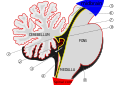
Hindbrain is the lower part of the brain that includes the cerebellum, pons, and medulla oblongata. It is responsible for various functions including motor skills, balance, and coordination. The hindbrain is one of the three major divisions of the brain, the other two being the midbrain and forebrain.
Structure[edit]
The hindbrain is composed of the metencephalon and myelencephalon. The metencephalon develops into the cerebellum and the pons, while the myelencephalon forms the medulla oblongata.
Cerebellum[edit]
The cerebellum is the largest structure in the hindbrain. It is responsible for coordinating voluntary movements, maintaining posture and balance, and integrating sensory information from the inner ear and muscles.
Pons[edit]
The pons is located above the medulla oblongata and below the midbrain. It serves as a message station between several areas of the brain, helping to relay messages from the cortex and the cerebellum.
Medulla Oblongata[edit]
The medulla oblongata is the lower half of the brainstem. It controls a number of critical bodily functions, including heart rate, breathing, blood pressure, and reflexes.
Function[edit]
The hindbrain plays a crucial role in controlling and coordinating basic life functions. It is involved in motor control, balance, and coordination. It also plays a role in sensory processing, particularly auditory and visual information.
Clinical Significance[edit]
Damage to the hindbrain can result in a variety of neurological disorders, including Ataxia, Locked-in syndrome, and Horner's syndrome. Treatment for these conditions often involves managing symptoms and improving quality of life.
See Also[edit]
 | This medical article is a stub. You can help WikiMD by expanding the page. |
-
 Hindbrain
 -
 Hindbrain


