Chondroblast: Difference between revisions
CSV import |
No edit summary |
||
| Line 36: | Line 36: | ||
[[Category:Tissue engineering]] | [[Category:Tissue engineering]] | ||
{{medicine-stub}} | {{medicine-stub}} | ||
== Chondroblast gallery == | == Chondroblast gallery == | ||
<gallery> | <gallery> | ||
File:Diagram of cartilage cells called chondroblasts CRUK 032.svg|Diagram of cartilage cells called chondroblasts | File:Diagram of cartilage cells called chondroblasts CRUK 032.svg|Diagram of cartilage cells called chondroblasts | ||
</gallery> | </gallery> | ||
Latest revision as of 20:14, 16 March 2025
Chondroblast
A chondroblast is a type of cell that plays a crucial role in the development and maintenance of cartilage. These cells are derived from mesenchymal stem cells and are responsible for the synthesis and secretion of the extracellular matrix components that form cartilage. Chondroblasts are essential during the early stages of chondrogenesis, the process by which cartilage is formed.
Function[edit]
Chondroblasts are primarily involved in the production of the extracellular matrix of cartilage, which includes collagen fibers, proteoglycans, and other essential molecules. These components provide the structural framework and mechanical properties of cartilage. Chondroblasts actively secrete these matrix components until they become entrapped within the matrix, at which point they differentiate into chondrocytes, the mature cartilage cells.
Differentiation[edit]
The differentiation of chondroblasts from mesenchymal stem cells is regulated by various growth factors and signaling pathways. Key factors involved in this process include transforming growth factor-beta (TGF-β), bone morphogenetic proteins (BMPs), and fibroblast growth factors (FGFs). These factors promote the expression of specific genes that drive the chondrogenic differentiation pathway.
Location[edit]
Chondroblasts are predominantly found in the perichondrium, a dense layer of connective tissue that surrounds cartilage. The perichondrium provides a source of progenitor cells that can differentiate into chondroblasts and contribute to the growth and repair of cartilage.
Clinical Significance[edit]
Chondroblasts are of significant interest in the field of regenerative medicine and tissue engineering due to their potential to generate new cartilage tissue. Understanding the biology and regulation of chondroblasts can aid in the development of therapies for cartilage repair and the treatment of cartilage-related disorders, such as osteoarthritis.
See Also[edit]
- Chondrocyte
- Cartilage
- Mesenchymal stem cell
- Extracellular matrix
- Chondrogenesis
- Perichondrium
- Osteoarthritis
References[edit]
<references group="" responsive="1"></references>
External Links[edit]


Chondroblast gallery[edit]
-
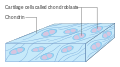 Diagram of cartilage cells called chondroblasts

