Psychodidae: Difference between revisions
CSV import |
CSV import |
||
| Line 26: | Line 26: | ||
{{stub}} | {{stub}} | ||
<gallery> | |||
File:Clogmia Albipunctata or moth fly.jpg|Clogmia Albipunctata or moth fly | |||
File:Datzia bispina Fig1 A.jpg|Datzia bispina Fig1 A | |||
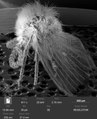
File:Psychodidae SEM top view.tif|Psychodidae SEM top view | |||
File:Psychodidae SEM rear view.tif|Psychodidae SEM rear view | |||
File:Psychodidae SEM view from left.tif|Psychodidae SEM view from left | |||
File:Psychodidae SEM front view.tif|Psychodidae SEM front view | |||
File:Psychodidae SEM whiskers.tif|Psychodidae SEM whiskers | |||
File:Psychodidae leg.tif|Psychodidae leg | |||
File:Notofairchildia zelandiae.jpg|Notofairchildia zelandiae | |||
</gallery> | |||
Latest revision as of 17:50, 3 March 2025
Psychodidae is a family of small mosquito-like insects, commonly known as sandflies, moth flies, or drain flies. They are found worldwide in over 2,600 species and are known for their nuisance value and role in the transmission of disease.
Description and Habitat[edit]
Psychodidae are small, hairy insects with a body length of 1.5 to 5 mm. They have broad, rounded wings and are weak fliers, typically found near their breeding sites. These sites are often damp environments, such as soil, decaying vegetation, or drains.
Behavior and Life Cycle[edit]
The life cycle of Psychodidae includes four stages: egg, larva, pupa, and adult. The duration of these stages can vary greatly depending on environmental conditions. Adults are nocturnal and are attracted to light.
Medical Importance[edit]
Some species of Psychodidae, particularly those in the genus Phlebotomus in the Old World and Lutzomyia in the New World, are vectors for various forms of leishmaniasis, a disease caused by protozoan parasites of the genus Leishmania. These diseases can cause significant morbidity and mortality in humans.
Control[edit]
Control of Psychodidae typically involves reducing potential breeding sites, such as standing water and organic debris. Insecticides can also be used, but their effectiveness can be limited due to the insects' resistance and the difficulty in reaching the breeding sites.
See Also[edit]
References[edit]
<references />