Right-hand rule: Difference between revisions
CSV import |
CSV import |
||
| Line 31: | Line 31: | ||
{{physics-stub}} | {{physics-stub}} | ||
<gallery caption="Right-hand rule"> | |||
File:Right-hand rule for cross product.png|Right-hand rule for cross product | |||
File:Fleming's right hand rule.png|Fleming's right hand rule | |||
File:Cartesian coordinate system handedness.svg|Cartesian coordinate system handedness | |||
File:Right-hand grip rule.svg|Right-hand grip rule | |||
File:Screw thread handedness.png|Screw thread handedness | |||
File:Manoderecha.svg|Manoderecha | |||
File:Coil right-hand rule.svg|Coil right-hand rule | |||
File:CHF 200 9 front.jpg|CHF 200 9 front | |||
</gallery> | |||
Latest revision as of 06:12, 3 March 2025

The Right-hand rule is a common mnemonic for understanding orientation conventions for vectors in three dimensions. Most commonly, it is used in physics and mathematics to determine the direction of the cross product of two vectors. This rule is a simple way to get the direction of certain vector operations without needing to perform the operation explicitly.
Overview[edit]
The Right-hand rule is applied by orienting the right hand such that the thumb points in the direction of the first vector (A) and the fingers point in the direction of the second vector (B). When you curl your fingers from A to B, your thumb will point in the direction of the cross product A × B. This rule helps in determining the direction of the resultant vector in a cross product operation, which is perpendicular to the plane formed by the two vectors.
Applications[edit]
The Right-hand rule is widely used in various branches of physics and engineering to determine directions of forces, fields, and currents. Some of the key applications include:
- In Electromagnetism, it is used to determine the direction of the magnetic force on a moving charge, the magnetic field around a current-carrying wire, and the direction of induced current in a wire.
- In Mechanics, it helps to determine the direction of angular velocity, angular momentum, and torque vectors.
- In Vector calculus, it is used for understanding the orientations of the gradient, curl, and divergence of vector fields.
Variations[edit]
There are several variations of the Right-hand rule, depending on the context and the specific operation being performed. These include the Fleming's left-hand rule for electric motors, the right-hand grip rule for magnetic fields, and others. Each variation is tailored to a specific type of vector operation or physical scenario.
See Also[edit]
References[edit]
<references/>

- Right-hand rule
-
 Right-hand rule for cross product
 -
 Fleming's right hand rule
 -
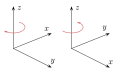 Cartesian coordinate system handedness
 -
 Right-hand grip rule
 -
 Screw thread handedness
 -
 Manoderecha
 -
 Coil right-hand rule
 -
 CHF 200 9 front


