Backlight: Difference between revisions
CSV import |
CSV import |
||
| Line 36: | Line 36: | ||
{{Display-stub}} | {{Display-stub}} | ||
== Backlight gallery == | |||
<gallery> | |||
File:Backlit LCD display.jpg|Backlit LCD display | |||
File:LCD-TV Backlight with CCFL.jpg|LCD TV Backlight with CCFL | |||
File:lcd-ccfl.svg|LCD CCFL | |||
File:lcd-led.svg|LCD LED | |||
</gallery> | |||
Latest revision as of 06:10, 3 March 2025

Backlight refers to a form of illumination used in liquid crystal displays (LCDs). Unlike cathode ray tube (CRT) displays or plasma displays, LCD panels do not produce light by themselves. Instead, they require an external source of light to produce a visible image. A backlight illuminates the LCD from the back or side of the display panel, enhancing the contrast and brightness, making it possible for the user to see the image.
Types of Backlight[edit]
There are several types of backlight technologies, each with its advantages and disadvantages. The most common types include:
- Cold Cathode Fluorescent Lamps (CCFL): Before the advent of LED technology, CCFLs were the most common type of backlight. They provide even lighting across the screen but are larger, consume more power, and have a shorter lifespan compared to LED backlights.
- Light Emitting Diodes (LED): LED backlights are more prevalent in modern displays due to their lower power consumption, longer lifespan, and smaller size. LED backlights can be further divided into two main types:
- Edge-lit LED: LEDs are placed around the edges of the screen. This setup allows for thinner displays but can result in uneven lighting.
- Full-array LED: LEDs are placed across the entire back of the display panel, allowing for better control of brightness and contrast through a technique known as local dimming.
Advantages of Backlighting[edit]
Backlighting in displays offers several advantages:
- Improved Visibility: Backlighting enhances the brightness and contrast of the display, making it easier to read or view images in various lighting conditions.
- Energy Efficiency: LED backlights, in particular, consume less power compared to other backlighting technologies and traditional display technologies like CRTs.
- Design Flexibility: The compact nature of LED backlights allows for thinner and lighter display designs.
Applications[edit]
Backlighting is used in a wide range of devices, including:
Challenges and Considerations[edit]
While backlighting technology has significantly improved over the years, there are still challenges and considerations:
- Uniformity: Achieving uniform backlighting across the entire display can be challenging, especially with edge-lit LED backlights.
- Color Reproduction: The quality of the backlight can affect the display's color accuracy and overall image quality.
- Power Consumption: Despite the efficiency of LEDs, backlighting still contributes significantly to the power consumption of a device.
Future of Backlight Technology[edit]
The future of backlight technology may see further improvements in LED efficiency, the development of more advanced local dimming techniques, and the exploration of alternative technologies such as organic light-emitting diodes (OLEDs) and micro-LEDs, which offer the potential for displays that do not require traditional backlighting.
Backlight gallery[edit]
-
 Backlit LCD display
 -
 LCD TV Backlight with CCFL
 -
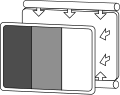 LCD CCFL
 -
 LCD LED


