Display device
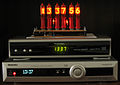
Display device refers to an output device for presenting information in visual or tactile form. When the input information is supplied as an electrical signal, the display is called an electronic display. Common applications for electronic visual displays are television sets or computer monitors.
Types of Display Devices[edit]
There are several types of display devices, each with its own advantages, disadvantages, and applications. The most common types include:
- Cathode Ray Tube (CRT): An older technology that uses electron beams to illuminate phosphors on the inside of a vacuum tube. Cathode Ray Tube displays are bulky and have largely been replaced by more modern technologies.
- Liquid Crystal Display (LCD): Utilizes liquid crystals that are manipulated in a matrix to display images. LCDs are thin, energy-efficient, and provide better color accuracy and resolution than CRTs. They are widely used in monitors, smartphones, and televisions.
- Light Emitting Diode (LED): An advancement of LCD technology, LED displays use light-emitting diodes for backlighting instead of the cold cathode fluorescent (CCFL) lighting used in traditional LCDs. This results in improved color and contrast.
- Organic Light Emitting Diode (OLED): A type of LED where the pixels emit their own light, allowing for deeper blacks and a higher contrast ratio. OLED displays are used in high-end smartphones and TVs.
- Plasma Display Panel (PDP): Uses small cells containing electrically charged ionized gases to display images. Plasma displays were known for their excellent color accuracy and contrast ratios but have been phased out in favor of LCD and OLED technologies.
Applications[edit]
Display devices serve a multitude of applications across various fields. Some of the primary applications include:
- Computing: As monitors for desktop computers, providing an interface for users to interact with the computer systems.
- Telecommunications: In smartphones and tablets, display devices are crucial for user interaction.
- Entertainment: Televisions and projectors use display technologies to present visual media to audiences.
- Advertising: Digital signage and billboards use large-scale display devices to broadcast advertisements and information.
- Medical: Specialized display devices are used in medical equipment for diagnostics and patient monitoring.
Future Trends[edit]
The future of display technology is likely to see further advancements in resolution, energy efficiency, and flexibility. Emerging technologies such as flexible OLED displays and MicroLEDs promise to offer improved performance and new applications, including wearable devices and foldable smartphones.
See Also[edit]
References[edit]
<references/>

-
 Display_device
 -
 Display_device
.jpg)

Ad. Transform your life with W8MD's
GLP-1 weight loss injections special from $29.99


W8MD Medical Weight Loss, Sleep and Medspa offers physician-supervised medical weight loss programs: NYC medical weight loss Philadelphia medical weight loss
Affordable GLP-1 Weight Loss ShotsAffordable GLP-1 Weight Loss Shots
Budget GLP-1 injections NYC (insurance & self-pay options) Popular treatments:
- Semaglutide starting from $29.99/week
- Tirzepatide starting from $45.00/week
✔ Most insurances accepted for visits ✔ Prior authorization support when eligible
Start your physician weight loss NYC journey today:
📍 NYC: Brooklyn weight loss center 📍 Philadelphia: Philadelphia weight loss center
📞 Call: 718-946-5500 (NYC) | 215-676-2334 (Philadelphia)
Tags: Affordable GLP1 weight loss NYC, Wegovy NYC, Zepbound NYC, Philadelphia medical weight loss


|
WikiMD Medical Encyclopedia |
Medical Disclaimer: WikiMD is not a substitute for professional medical advice. The information on WikiMD is provided as an information resource only, may be incorrect, outdated or misleading, and is not to be used or relied on for any diagnostic or treatment purposes. Please consult your health care provider before making any healthcare decisions or for guidance about a specific medical condition. WikiMD expressly disclaims responsibility, and shall have no liability, for any damages, loss, injury, or liability whatsoever suffered as a result of your reliance on the information contained in this site. By visiting this site you agree to the foregoing terms and conditions, which may from time to time be changed or supplemented by WikiMD. If you do not agree to the foregoing terms and conditions, you should not enter or use this site. See full disclaimer.
Credits:Most images are courtesy of Wikimedia commons, and templates, categories Wikipedia, licensed under CC BY SA or similar.
Translate this page: - East Asian
中文,
日本,
한국어,
South Asian
हिन्दी,
தமிழ்,
తెలుగు,
Urdu,
ಕನ್ನಡ,
Southeast Asian
Indonesian,
Vietnamese,
Thai,
မြန်မာဘာသာ,
বাংলা
European
español,
Deutsch,
français,
Greek,
português do Brasil,
polski,
română,
русский,
Nederlands,
norsk,
svenska,
suomi,
Italian
Middle Eastern & African
عربى,
Turkish,
Persian,
Hebrew,
Afrikaans,
isiZulu,
Kiswahili,
Other
Bulgarian,
Hungarian,
Czech,
Swedish,
മലയാളം,
मराठी,
ਪੰਜਾਬੀ,
ગુજરાતી,
Portuguese,
Ukrainian

