Messenger line: Difference between revisions
CSV import |
CSV import |
||
| Line 24: | Line 24: | ||
[[Category:Nautical terminology]] | [[Category:Nautical terminology]] | ||
{{nautical-stub}} | {{nautical-stub}} | ||
== Messenger line gallery == | |||
<gallery> | |||
File:Coast Guard sailor deploys a messenger line.jpg|Coast Guard sailor deploys a messenger line | |||
</gallery> | |||
Latest revision as of 05:57, 3 March 2025
Messenger line is a term used in maritime operations, specifically in the field of mooring and towing. It refers to a lightweight rope that is used to pull a heavier rope or cable from one location to another. The messenger line is typically thrown or shot over a distance, carrying with it the end of the heavier line. This process is often used in ship-to-ship transfers, docking operations, and rescue missions.
History[edit]
The use of messenger lines dates back to the age of sail, when they were used to haul larger, heavier lines between ships or from ship to shore. The term "messenger" comes from the line's function of "sending" or "delivering" the larger line to its destination.
Usage[edit]
In modern maritime operations, the messenger line is often used in conjunction with a heaving line. The heaving line is a smaller, lighter line that can be easily thrown over a distance. Once the heaving line is in place, it is used to pull the messenger line, which in turn is used to pull the larger, heavier line or cable.
In rescue operations, a messenger line can be used to deliver a lifeline or other rescue equipment to a person in the water. The messenger line is thrown to the person, who then uses it to pull the lifeline or equipment to their location.
Construction[edit]
Messenger lines are typically made of lightweight, strong materials such as nylon or polypropylene. They are often brightly colored for visibility, and may have a weighted end to aid in throwing.
See also[edit]
Messenger line gallery[edit]
-
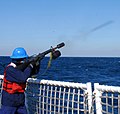 Coast Guard sailor deploys a messenger line

