Resin extraction: Difference between revisions
CSV import |
CSV import |
||
| Line 42: | Line 42: | ||
{{Forestry-stub}} | {{Forestry-stub}} | ||
{{food-stub}} | {{food-stub}} | ||
<gallery> | |||
File:Gemmage1.JPG|Gemmage | |||
File:Resin extraction near Irkutsk.jpg|Resin extraction near Irkutsk | |||
File:Resin extraction in Cortegaça (Mortágua).jpg|Resin extraction in Cortegaça (Mortágua) | |||
File:Kombornia zywicowanie.jpg|Kombornia zywicowanie | |||
File:Getah hars Pinus Panji DSC 0622-.JPG|Getah hars Pinus Panji | |||
</gallery> | |||
Latest revision as of 05:54, 3 March 2025
Resin Extraction
Resin extraction is a process that involves the collection of resin, a viscous substance secreted by certain plants and trees. This process has been practiced for centuries and is used in a variety of industries, including the production of varnish, adhesive, and incense.
History[edit]
The extraction of resin has a long history, dating back to ancient civilizations. The Ancient Egyptians used resin in the mummification process, while the Ancient Greeks and Romans used it as an adhesive and a sealant. In the Middle Ages, resin was used in the production of varnishes and lacquers.
Types of Resin[edit]
There are several types of resin that can be extracted, each with its own unique properties and uses. These include:
- Amber: This is fossilized tree resin that has been appreciated for its color and natural beauty since Neolithic times.
- Rosin: This is a solid form of resin obtained from pines and other plants, mostly conifers, produced by heating fresh liquid resin to vaporize the volatile liquid terpene components.
- Frankincense: This is an aromatic resin used in incense and perfumes, obtained from trees of the genus Boswellia.
- Myrrh: This is a natural gum or resin extracted from a number of small, thorny tree species of the genus Commiphora.
Extraction Process[edit]
The process of resin extraction varies depending on the type of resin and the plant from which it is being extracted. Generally, the process involves making a cut or incision into the plant or tree and allowing the resin to seep out. The resin is then collected and processed for use.
Uses[edit]
Resin has a wide range of uses in various industries. It is used in the production of varnishes and adhesives, as well as in the manufacture of incense and perfumes. Resin is also used in the production of certain types of paint, and in the pharmaceutical industry for its medicinal properties.
Environmental Impact[edit]
While resin extraction can be a sustainable practice if managed properly, it can also have negative environmental impacts if not regulated. Over-extraction can lead to the depletion of resin-producing plants and trees, and can disrupt local ecosystems.
See Also[edit]


-
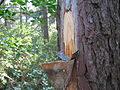 Gemmage
 -
 Resin extraction near Irkutsk
 -
 Resin extraction in Cortegaça (Mortágua)
 -
 Kombornia zywicowanie
 -
 Getah hars Pinus Panji


.jpg)


