Retortamonas: Difference between revisions
CSV import |
CSV import |
||
| Line 59: | Line 59: | ||
[[Category:Protists]] | [[Category:Protists]] | ||
[[Category:Intestinal parasites]] | [[Category:Intestinal parasites]] | ||
<gallery> | |||
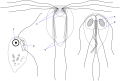
File:Metamonada retortamonas hexamita giardia.svg|Metamonada retortamonas hexamita giardia | |||
</gallery> | |||
Latest revision as of 05:52, 3 March 2025
Retortamonas
Retortamonas is a genus of flagellate protists that are part of the phylum Metamonada. These organisms are primarily known for their presence in the intestines of various animals, including humans, where they exist as commensals. The most studied species within this genus is Retortamonas intestinalis.
Taxonomy[edit]
Retortamonas belongs to the:
- Domain: Eukaryota
- Kingdom: Excavata
- Phylum: Metamonada
- Class: Retortamonadea
- Order: Retortamonadida
- Family: Retortamonadidae
- Genus: Retortamonas
Morphology[edit]
Retortamonas species are characterized by their small size and simple structure. They possess:
- A single nucleus
- Two flagella, one of which is directed posteriorly
- A cytostome, which is a cell mouth used for ingesting food particles
The organisms are typically pear-shaped and measure approximately 5-10 micrometers in length.
Life Cycle[edit]
The life cycle of Retortamonas includes both trophozoite and cyst stages:
- Trophozoite Stage: The active, feeding stage of the organism. Trophozoites reside in the host's intestine and are responsible for the commensal relationship.
- Cyst Stage: The dormant, resistant stage that allows the organism to survive outside the host. Cysts are the form that is transmitted from one host to another, typically through fecal-oral contamination.
Habitat and Ecology[edit]
Retortamonas species are found in the intestines of a variety of hosts, including:
- Humans
- Non-human primates
- Other mammals
They are considered non-pathogenic and are often found in association with other intestinal protozoa such as Giardia and Chilomastix.
Clinical Significance[edit]
While Retortamonas is generally considered non-pathogenic, its presence can be indicative of fecal contamination and poor sanitation. It is often detected in stool samples during routine parasitological examinations.
Diagnosis[edit]
Diagnosis of Retortamonas infection is typically made through:
- Microscopic examination of stool samples
- Identification of characteristic cysts or trophozoites
Prevention and Control[edit]
Preventive measures include:
- Ensuring access to clean water
- Practicing good hygiene and sanitation
- Proper disposal of human and animal waste
Also see[edit]
| Protozoa | ||||||||||
|---|---|---|---|---|---|---|---|---|---|---|
|
-
 Metamonada retortamonas hexamita giardia

