Shorea robusta: Difference between revisions
CSV import Tags: mobile edit mobile web edit |
CSV import Tags: mobile edit mobile web edit |
||
| Line 24: | Line 24: | ||
{{trees-stub}} | {{trees-stub}} | ||
{{food-stub}} | {{food-stub}} | ||
<gallery> | |||
File:Shorea robusta.jpg|Shorea robusta | |||
File:Sal forests in Purulia, West Bengal, India.jpg|Sal forests in Purulia, West Bengal, India | |||
File:Birth of Buddha at Lumbini.jpg|Birth of Buddha at Lumbini | |||
File:Shal leaf plate in illambazar santiniketan west bengal india.jpg|Shal leaf plate in Illambazar, Santiniketan, West Bengal, India | |||
File:Managed Sal forest in Dehradun.jpg|Managed Sal forest in Dehradun | |||
File:Sal (Shorea robusta)- trunk- strangulated by some ficus tree at Jayanti, Duars W Picture 119.jpg|Sal (Shorea robusta) trunk strangulated by some ficus tree at Jayanti, Duars | |||
File:Sal (Shorea robusta)- new leaves with flower buds at Jayanti, Duars W Picture 120.jpg|Sal (Shorea robusta) new leaves with flower buds at Jayanti, Duars | |||
File:Sal (Shorea robusta)- old leaf at Jayanti, Duars W Picture 122.jpg|Sal (Shorea robusta) old leaf at Jayanti, Duars | |||
File:Shala Tree in full bloom.jpg|Shala Tree in full bloom | |||
File:India, tre dee, salabhanjika, periodo hoysala 1150-1200 da Karnataka.JPG|India, tre dee, salabhanjika, periodo hoysala 1150-1200 da Karnataka | |||
</gallery> | |||
Latest revision as of 05:48, 3 March 2025
Shorea robusta, also known as the Sal tree, is a species of tree belonging to the Dipterocarpaceae family. It is native to the Indian subcontinent and is significant in the Hindu religion.
Description[edit]
The Shorea robusta tree can grow up to 35 meters in height and has a large, cylindrical trunk. The bark is thick and grey, with deep vertical fissures. The leaves are simple, shiny, and have a leathery texture. The tree produces small, white flowers in large racemes, and its fruit is a nut, surrounded by a flat, wing-like structure.
Distribution and Habitat[edit]
Shorea robusta is found throughout the Indian subcontinent, including India, Nepal, Bangladesh, and Sri Lanka. It prefers a warm, tropical climate and is commonly found in deciduous forests, often forming pure stands.
Uses[edit]
The wood of the Shorea robusta tree is hard and durable, making it suitable for construction and furniture making. The tree's resin, known as Sal Dammar, is used in the production of varnish and incense. The leaves are used for serving food in many parts of India.
Cultural Significance[edit]
In the Hindu religion, the Shorea robusta tree is considered sacred. It is often mentioned in ancient Indian texts and is associated with several deities. The tree is also used in traditional medicine in India.
Conservation[edit]
While the Shorea robusta tree is not currently considered endangered, it is under threat from deforestation and habitat loss. Conservation efforts are focused on protecting existing populations and promoting sustainable harvesting practices.
This tree-related article is a stub. You can help WikiMD by expanding it.

-
 Shorea robusta
 -
 Sal forests in Purulia, West Bengal, India
 -
 Birth of Buddha at Lumbini
 -
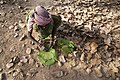 Shal leaf plate in Illambazar, Santiniketan, West Bengal, India
 -
 Managed Sal forest in Dehradun
 -
 Sal (Shorea robusta) trunk strangulated by some ficus tree at Jayanti, Duars
 -
 Sal (Shorea robusta) new leaves with flower buds at Jayanti, Duars
 -
 Sal (Shorea robusta) old leaf at Jayanti, Duars
 -
 Shala Tree in full bloom
 -
 India, tre dee, salabhanjika, periodo hoysala 1150-1200 da Karnataka


-_trunk-_strangulated_by_some_ficus_tree_at_Jayanti,_Duars_W_Picture_119.jpg)
-_new_leaves_with_flower_buds_at_Jayanti,_Duars_W_Picture_120.jpg)
-_old_leaf_at_Jayanti,_Duars_W_Picture_122.jpg)


