Rebreather diving: Difference between revisions
CSV import |
CSV import |
||
| Line 40: | Line 40: | ||
{{Scuba-stub}} | {{Scuba-stub}} | ||
== Rebreather diving gallery == | |||
<gallery> | |||
File:USMC combatant diving (2nd Recon Bn).jpg|USMC combatant diving (2nd Recon Bn) | |||
File:Aa US Navy explosive ordnance disposal (EOD) divers.jpg|US Navy explosive ordnance disposal (EOD) divers | |||
File:Deepursuit.jpg|Deepursuit | |||
File:CMF SCR loop schematic.png|CMF SCR loop schematic | |||
File:Passive addition SCR loop schematic.png|Passive addition SCR loop schematic | |||
File:Draeger Dolphin SCR DSC05264.JPG|Draeger Dolphin SCR | |||
File:Halcyon PVR-BASC P5167709.JPG|Halcyon PVR-BASC | |||
File:Diver using Inspiration rebreather at the wreck of the MV Orotava P6308046.JPG|Diver using Inspiration rebreather at the wreck of the MV Orotava | |||
File:Diver using Inspiration rebreather at the wreck of the MV Orotava P6308040.JPG|Diver using Inspiration rebreather at the wreck of the MV Orotava | |||
File:Diver using Inspiration rebreather at the wreck of the MV Orotava P6308043.jpg|Diver using Inspiration rebreather at the wreck of the MV Orotava | |||
</gallery> | |||
Latest revision as of 05:43, 3 March 2025
Rebreather diving is a type of scuba diving where the diver uses a rebreather instead of an open-circuit diving set. As opposed to exhaling exhaled air out into the water, a rebreather reprocesses each breath to make it breathable again.
History[edit]
The concept of rebreathing has been around for several centuries. The first true rebreather was invented by Henry Fleuss in 1878, while working for Siebe Gorman in London. His device was made to supply divers with a constant flow of air. It was also used to supply firemen and miners with breathable air in dangerous situations.
Types of Rebreathers[edit]
There are three main types of rebreathers: oxygen rebreathers, semi-closed circuit rebreathers, and closed circuit rebreathers.
Oxygen Rebreathers[edit]
Oxygen rebreathers carry a supply of nearly pure oxygen which is recycled and breathed by the diver. They are the simplest type of rebreather but have a limited depth range due to oxygen toxicity risk.
Semi-Closed Circuit Rebreathers[edit]
Semi-closed circuit rebreathers recycle some of the exhaled gas and add a constant flow of gas into the breathing loop. They are more complex than oxygen rebreathers and can be used at greater depths.
Closed Circuit Rebreathers[edit]
Closed circuit rebreathers (CCRs) recycle all of the exhaled gas and add only the gas that is metabolised by the diver. They are the most complex type of rebreather and can be used at the greatest depths.
Advantages and Disadvantages[edit]
Rebreather diving has several advantages over open circuit diving, such as longer dive times and a quieter dive experience. However, they are also more complex and require more maintenance and training to use safely.
Safety[edit]
Rebreather diving requires special training and certification due to the increased complexity and potential risks. Divers must be trained to manage potential issues such as oxygen toxicity, carbon dioxide buildup, and equipment failure.
See Also[edit]
 | |
|---|---|
 |
 |
Rebreather diving gallery[edit]
-
 USMC combatant diving (2nd Recon Bn)
 -
 US Navy explosive ordnance disposal (EOD) divers
 -
Deepursuit
-
 CMF SCR loop schematic
 -
 Passive addition SCR loop schematic
 -
 Draeger Dolphin SCR
 -
 Halcyon PVR-BASC
 -
 Diver using Inspiration rebreather at the wreck of the MV Orotava
 -
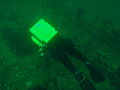 Diver using Inspiration rebreather at the wreck of the MV Orotava
 -
 Diver using Inspiration rebreather at the wreck of the MV Orotava
.jpg)
_divers.jpg)


