Menes: Difference between revisions
CSV import Tags: mobile edit mobile web edit |
CSV import |
||
| Line 28: | Line 28: | ||
[[Category:Ancient Egyptian myths and legends]] | [[Category:Ancient Egyptian myths and legends]] | ||
{{history-stub}} | {{history-stub}} | ||
== Menes gallery == | |||
<gallery> | |||
File:Abydos KL 01-01 n01.jpg|Abydos KL 01-01 n01 | |||
File:Hieroglyph names of Menes.jpg|Hieroglyph names of Menes | |||
File:C+B-Egypt-Fig10-TabletOfMenesFromNaqada.PNG|Tablet of Menes from Naqada | |||
File:Naqad Label.jpg|Naqad Label | |||
File:Ebony plaque of Menes in his tomb of Abydos (photograph).jpg|Ebony plaque of Menes in his tomb of Abydos (photograph) | |||
File:Ebony plaque of Menes in his tomb of Abydos (drawing).jpg|Ebony plaque of Menes in his tomb of Abydos (drawing) | |||
File:Labels from the tomb of Menes.jpg|Labels from the tomb of Menes | |||
</gallery> | |||
Latest revision as of 05:40, 3 March 2025

Menes (Ancient Egyptian: *mnj*) is a pharaoh of the Early Dynastic Period of Egypt, credited by classical tradition with having united Upper Egypt and Lower Egypt and as the founder of the First Dynasty.
Biography[edit]
Menes is a legendary figure in Egyptian history, and his true identity and accomplishments are the subject of ongoing academic debate. He is often identified with Narmer, a pharaoh of the same period, due to the discovery of the Narmer Palette, an archaeological artifact that depicts the unification of Egypt. However, some scholars distinguish between Narmer and Menes, considering them separate entities.
According to Manetho, an Egyptian priest from the Ptolemaic Kingdom who wrote an Egyptian history in the 3rd century BCE, Menes reigned for 62 years and was killed by a hippopotamus. This account, however, is considered more mythological than historical.
Unification of Egypt[edit]
The most significant achievement attributed to Menes is the unification of Upper and Lower Egypt. Before Menes, the Nile River valley was divided into two distinct regions: Upper Egypt, to the south, and Lower Egypt, to the north. The unification is not only a political and military achievement but also a cultural and religious one, leading to the flourishing of Ancient Egyptian civilization.
Legacy[edit]
Menes' legacy is a foundational part of Egyptian history. He is credited with founding Memphis, which would become the capital of Ancient Egypt for over eight centuries. He also established the first of the dynasties of ancient Egypt, which would rule Egypt for the next three millennia.
Menes' unification of Egypt set the stage for the age of the pharaohs, a period marked by significant advancements in art, architecture, and science. His achievements are commemorated in numerous literary and archaeological sources, making him a central figure in Egypt's storied past.
Controversy and Historical Debate[edit]
The historical figure of Menes is shrouded in mystery. The lack of contemporary records from his time makes it difficult to separate fact from legend. The identification of Menes with Narmer, based on archaeological evidence like the Narmer Palette, is a subject of ongoing debate among Egyptologists. This debate extends to the very existence of Menes as a historical figure, with some scholars suggesting that Menes may be a legendary or symbolic figure representing the concept of dynastic unification rather than an individual.
See Also[edit]

Menes gallery[edit]
-
 Abydos KL 01-01 n01
 -
 Hieroglyph names of Menes
 -
 Tablet of Menes from Naqada
 -
Naqad Label
-
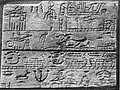 Ebony plaque of Menes in his tomb of Abydos (photograph)
 -
 Ebony plaque of Menes in his tomb of Abydos (drawing)
 -
 Labels from the tomb of Menes


.jpg)
.jpg)


