Rickettsia typhi: Difference between revisions
CSV import |
CSV import |
||
| Line 33: | Line 33: | ||
{{bacteria-stub}} | {{bacteria-stub}} | ||
{{medicine-stub}} | {{medicine-stub}} | ||
<gallery> | |||
File:Epidemic Typhus. Macular rash 1.png|Epidemic Typhus Macular Rash | |||
File:Auckland City - Harbour Publicity Caption Auckland City Views Big ships, Little ships in port. Photographer G. Riethmaier.jpg|Auckland City Harbour Publicity | |||
File:Xenopsylla cheopis ZSM.jpg|Xenopsylla cheopis | |||
File:Chicken egg diagram.svg|Chicken Egg Diagram | |||
</gallery> | |||
Latest revision as of 05:40, 3 March 2025
Rickettsia typhi is a small, rod-shaped, Gram-negative, intracellular parasite that belongs to the genus Rickettsia. It is the causative agent of Murine typhus, a disease transmitted to humans through the bite of infected fleas.
Taxonomy[edit]
Rickettsia typhi is a member of the family Rickettsiaceae, in the order Rickettsiales, within the class Alphaproteobacteria. It is one of the most well-known species of the genus Rickettsia, which also includes other important human pathogens such as Rickettsia rickettsii and Rickettsia prowazekii.
Morphology[edit]
Rickettsia typhi is a small, rod-shaped bacterium, typically measuring 0.3 to 0.5 μm in width and 1.0 to 2.0 μm in length. Like all Rickettsia species, it is Gram-negative, meaning it does not retain the violet Gram stain used in laboratory identification of bacteria.
Life Cycle and Transmission[edit]
Rickettsia typhi is an obligate intracellular parasite, meaning it can only survive and reproduce inside the cells of a host organism. The primary hosts of R. typhi are rats, in which the bacteria live in the endothelial cells lining the blood vessels. The bacteria are transmitted to humans through the bite of an infected flea, most commonly the Oriental rat flea (Xenopsylla cheopis).
Disease[edit]
In humans, Rickettsia typhi causes Murine typhus, also known as endemic typhus or flea-borne typhus. Symptoms of the disease include fever, headache, rash, and muscle pain. If left untreated, Murine typhus can lead to serious complications such as pneumonia, meningitis, and kidney failure.
Treatment and Prevention[edit]
Murine typhus can be effectively treated with the antibiotic doxycycline. Prevention of the disease involves controlling rat and flea populations, as well as avoiding contact with these animals.
See Also[edit]


-
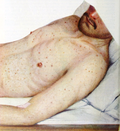 Epidemic Typhus Macular Rash
 -
 Auckland City Harbour Publicity
 -
 Xenopsylla cheopis
 -
 Chicken Egg Diagram


