Bait ball: Difference between revisions
CSV import Tags: mobile edit mobile web edit |
CSV import |
||
| Line 27: | Line 27: | ||
{{Fish-stub}} | {{Fish-stub}} | ||
{{food-stub}} | {{food-stub}} | ||
<gallery> | |||
File:Moofushi Kandu fish.jpg|Moofushi Kandu fish | |||
File:Beautiful sardine.jpg|Beautiful sardine | |||
File:Large fish school.png|Large fish school | |||
File:Humpback lunge feeding.jpg|Humpback lunge feeding | |||
File:Xiphias gladius1.jpg|Xiphias gladius | |||
File:Alopias vulpinus.jpg|Alopias vulpinus | |||
File:Carcharhinus brevipinna.jpg|Carcharhinus brevipinna | |||
File:Morus serrator.jpg|Morus serrator | |||
File:Istiophorus platypterus.jpg|Istiophorus platypterus | |||
File:Humpback-bubble-spiral-large Olson.jpg|Humpback bubble spiral | |||
</gallery> | |||
Latest revision as of 05:31, 3 March 2025
Bait ball, also known as bait school, is a phenomenon in the marine world where small fish swarm in a tightly packed spherical formation. This behavior is a defensive mechanism against predators.
Overview[edit]
A bait ball is a last-ditch defensive measure adopted by small schooling fish when they are threatened by predators. The phenomenon often occurs near the surface of the water, allowing for spectacular views for divers and bird watchers. The formation of a bait ball can be a sign of a nearby predator.
Formation[edit]
The formation of a bait ball is a complex process that involves the collective movement of thousands, sometimes millions, of individual fish. The fish move in unison, creating a swirling mass that can confuse and deter predators. The formation of a bait ball is often triggered by the presence of a large predator such as a shark or dolphin.
Survival Strategy[edit]
The bait ball strategy is not without its risks. While it can confuse individual predators, the spectacle of a bait ball can attract multiple predators, leading to a feeding frenzy. However, the tightly packed formation can make it difficult for any single predator to target and capture individual fish.
Species[edit]
Many species of small fish form bait balls. These include sardines, herring, and anchovies. Larger predatory species that can trigger the formation of bait balls include sharks, dolphins, and certain species of tuna and billfish.
In Popular Culture[edit]
Bait balls have been featured in numerous nature documentaries, including the BBC's The Blue Planet and Planet Earth series. They are also a popular subject for underwater photographers and videographers.
See Also[edit]
This marine-related article is a stub. You can help WikiMD by expanding it.


-
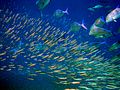 Moofushi Kandu fish
 -
 Beautiful sardine
 -
 Large fish school
 -
 Humpback lunge feeding
 -
 Xiphias gladius
 -
 Alopias vulpinus
 -
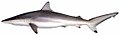 Carcharhinus brevipinna
 -
 Morus serrator
 -
 Istiophorus platypterus
 -
 Humpback bubble spiral


