Sephardic Jews: Difference between revisions
CSV import Tags: mobile edit mobile web edit |
CSV import |
||
| Line 34: | Line 34: | ||
{{Portugal-stub}} | {{Portugal-stub}} | ||
{{food-stub}} | {{food-stub}} | ||
<gallery> | |||
File:Sephardi Jew family Argentina (cr).jpg|Sephardi Jew family Argentina | |||
File:Fête juive à Tétouan, Alfred Dehodencq, 1865.jpg|Fête juive à Tétouan, Alfred Dehodencq, 1865 | |||
File:Al-andalus 229.png|Al-andalus | |||
File:Havdal.jpg|Havdal | |||
File:Massacre de lisboa.jpg|Massacre de lisboa | |||
File:Interieur van de Portugese synagoge te Amsterdam, SK-A-3738.jpg|Interieur van de Portugese synagoge te Amsterdam | |||
File:Execution of Mariana de Carabajal.jpg|Execution of Mariana de Carabajal | |||
File:Bundesarchiv Bild 101I-179-1575-08, Ioannina, Deportation von Juden.jpg|Deportation of Jews in Ioannina | |||
File:A Expulsão dos Judeus (Roque Gameiro, Quadros da História de Portugal, 1917).png|A Expulsão dos Judeus, Roque Gameiro, 1917 | |||
File:1900 photo of a Sephardi couple from Sarajevo.png|1900 photo of a Sephardi couple from Sarajevo | |||
</gallery> | |||
Latest revision as of 05:30, 3 March 2025
Sephardic Jews are a Jewish ethnic division originating from traditionally established communities in the Iberian Peninsula (modern-day Spain and Portugal). The term "Sephardic" is derived from Sepharad, a Biblical location, which is identified as Hispania, or the Iberian Peninsula.
History[edit]
The history of the Sephardic Jews is rich and complex, with roots tracing back to the Jews of Spain and Portugal. In the late 15th century, the Alhambra Decree or the Edict of Expulsion was issued by the Catholic Monarchs of Spain, leading to a mass exodus of Sephardic Jews. Many sought refuge in the Ottoman Empire, North Africa, Italy, and the Netherlands, significantly influencing the culture and development of these regions.
Culture[edit]
Sephardic Jews have a distinct culture that is a blend of their Jewish heritage and the various cultures of the countries they have lived in. Their unique traditions are reflected in their language, music, cuisine, and religious practices. The Ladino language, also known as Judeo-Spanish, is a Romance language derived from Old Spanish, traditionally spoken by Sephardic Jews.
Sephardic cuisine is a significant aspect of their culture, with dishes that are a unique blend of Jewish and local culinary traditions. Some popular Sephardic dishes include bourekas, baklava, and shakshuka.
Religion[edit]
Religiously, Sephardic Jews follow the Sephardic Halakha, their own interpretation of Jewish law, which differs in some aspects from the Ashkenazi Halakha. They have their own liturgy, known as Nusach Sepharad, which is used in their synagogues.
Sephardic Jews Today[edit]
Today, Sephardic Jews are found all over the world, with significant communities in Israel, France, the United States, Turkey, Argentina, and Brazil. They continue to preserve their unique traditions and contribute to the diversity of the global Jewish community.
See Also[edit]
- History of the Jews in Spain
- History of the Jews in Portugal
- Crypto-Judaism
- Marranos
- Spanish Inquisition


-
 Sephardi Jew family Argentina
 -
 Fête juive à Tétouan, Alfred Dehodencq, 1865
 -
 Al-andalus
 -
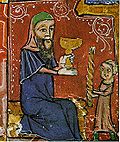 Havdal
 -
 Massacre de lisboa
 -
 Interieur van de Portugese synagoge te Amsterdam
 -
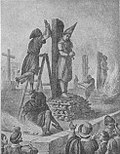 Execution of Mariana de Carabajal
 -
 Deportation of Jews in Ioannina
 -
 A Expulsão dos Judeus, Roque Gameiro, 1917
 -
 1900 photo of a Sephardi couple from Sarajevo
.jpg)


.png)

