Blue Ridge Mountains: Difference between revisions
CSV import Tags: mobile edit mobile web edit |
CSV import |
||
| Line 29: | Line 29: | ||
[[Category:Appalachian Mountains]] | [[Category:Appalachian Mountains]] | ||
{{mountain-stub}} | {{mountain-stub}} | ||
== Blue Ridge Mountains gallery == | |||
<gallery> | |||
File:Blue Ridge Province.jpg|Blue Ridge Province | |||
File:Blue Ridge Mountains - Front Royal, Virginia.jpg|Blue Ridge Mountains - Front Royal, Virginia | |||
File:Blowing Rock.jpg|Blowing Rock | |||
File:Blue Ridge Nelson Co VA.jpg|Blue Ridge Nelson Co VA | |||
File:Chimney Rock Mountain Overlook.jpg|Chimney Rock Mountain Overlook | |||
File:South Mountain-airphoto.jpg|South Mountain airphoto | |||
File:Blue Ridge Mountains from Liberty University in Lynchburg, VA IMG 4115.JPG|Blue Ridge Mountains from Liberty University in Lynchburg, VA | |||
File:Blue Ridge Parkway by Grandfather Mountain NC.jpg|Blue Ridge Parkway by Grandfather Mountain NC | |||
</gallery> | |||
Latest revision as of 05:07, 3 March 2025
Blue Ridge Mountains
The Blue Ridge Mountains are a physiographic province of the larger Appalachian Mountains range. This province consists of northern and southern physiographic regions, which divide near the Roanoke River gap. The mountain range is located in the eastern United States, and extends from its most northerly point in Pennsylvania to its most southerly point in Georgia. The Blue Ridge Mountains are noted for having a bluish color when seen from a distance. Trees put the "blue" in Blue Ridge, from the isoprene released into the atmosphere, thereby contributing to the characteristic haze on the mountains and their distinctive color.
Geography[edit]
The Blue Ridge Mountains span several states, including Pennsylvania, Maryland, Virginia, North Carolina, South Carolina, Tennessee, and Georgia. The highest peak in the Blue Ridge is Mount Mitchell in North Carolina at 6,684 feet, which is the highest peak east of the Mississippi River.
Geology[edit]
The Blue Ridge Mountains are comprised of rocks aged between 1.1 billion and 250 million years old. Geologists have identified various rocks in the Blue Ridge, including gneiss, granite, quartzite, and schist. The mountains are known for their rich deposits of gemstones and minerals.
Flora and Fauna[edit]
The Blue Ridge Mountains are home to a diverse range of plant and animal species. The region is part of the temperate deciduous forest biome, and the flora includes a variety of trees such as oak, hickory, and poplar, as well as a diverse array of wildflowers. The fauna includes species such as the black bear, white-tailed deer, and various bird species.
Recreation[edit]
The Blue Ridge Mountains offer numerous recreational opportunities. The Blue Ridge Parkway and the Appalachian Trail are the most well-known attractions. Other activities include hiking, bird watching, and mountain biking.
See Also[edit]

Blue Ridge Mountains gallery[edit]
-
 Blue Ridge Province
 -
 Blue Ridge Mountains - Front Royal, Virginia
 -
 Blowing Rock
 -
 Blue Ridge Nelson Co VA
 -
 Chimney Rock Mountain Overlook
 -
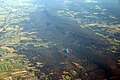 South Mountain airphoto
 -
 Blue Ridge Mountains from Liberty University in Lynchburg, VA
 -
 Blue Ridge Parkway by Grandfather Mountain NC


