Austrobaileyales: Difference between revisions
CSV import |
CSV import |
||
| Line 28: | Line 28: | ||
{{botany-stub}} | {{botany-stub}} | ||
{{medicine-stub}} | {{medicine-stub}} | ||
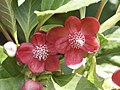
<gallery> | |||
File:Schisandra rubriflora.jpg|Schisandra rubriflora | |||
</gallery> | |||
Latest revision as of 05:01, 3 March 2025
Austrobaileyales is an order of flowering plants that is considered to be one of the most primitive groups of angiosperms. The order is named after the Australian genus Austrobaileya, which is included in this group.
Taxonomy[edit]
The order Austrobaileyales was first recognized by the Angiosperm Phylogeny Group (APG) in their APG II system in 2003. It includes three families: Austrobaileyaceae, Schisandraceae, and Trimeniaceae.
- Austrobaileyaceae is a family of flowering plants that includes only one genus, Austrobaileya. This genus contains a single species, Austrobaileya scandens, which is a woody vine native to the rainforests of northeastern Australia.
- Schisandraceae is a family of flowering plants that includes about 92 species in 3 genera. The best-known genus is Schisandra, which includes the medicinal plant Schisandra chinensis.
- Trimeniaceae is a family of flowering plants that includes about 12 species in 3 genera. The best-known genus is Trimenia, which includes the tree species Trimenia moorei.
Characteristics[edit]
Austrobaileyales are characterized by their primitive floral structures, which include spiral phyllotaxis (the arrangement of leaves on a stem), numerous stamens, and a lack of clear differentiation between petals and sepals. They also have a unique type of pollen known as inaperturate, which lacks an opening for the pollen tube to emerge.
Evolution[edit]
The Austrobaileyales are considered to be one of the most primitive groups of angiosperms, based on both morphological and molecular evidence. They are thought to have diverged from the main line of flowering plant evolution very early, possibly in the Cretaceous period.
References[edit]
<references />


-
 Schisandra rubriflora

