Chalciporus piperatus: Difference between revisions
CSV import Tags: mobile edit mobile web edit |
CSV import |
||
| Line 22: | Line 22: | ||
{{Mycology-stub}} | {{Mycology-stub}} | ||
== Chalciporus piperatus gallery == | |||
<gallery> | |||
File:Chalciporus piperatus LC0182.jpg|Chalciporus piperatus LC0182 | |||
File:Coloured Figures of English Fungi or Mushrooms - t. 34.jpg|Coloured Figures of English Fungi or Mushrooms - t. 34 | |||
File:2010-08-11 Chalciporus piperatus (Bull.) Bataille 99106.jpg|2010-08-11 Chalciporus piperatus (Bull.) Bataille 99106 | |||
File:2006-09-10 Chalciporus piperatus 26645.jpg|2006-09-10 Chalciporus piperatus 26645 | |||
</gallery> | |||
Latest revision as of 04:59, 3 March 2025

Chalciporus piperatus, commonly known as the peppery bolete, is a species of mushroom belonging to the family Boletaceae. This small to medium-sized bolete is notable for its distinctive peppery taste, which sets it apart from many other members of its family. It is found in various parts of the world, primarily in Europe and North America, where it forms mycorrhizal associations with a variety of tree species, particularly with pines.
Description[edit]
Chalciporus piperatus features a cap that ranges from 2 to 7 cm in diameter, initially convex before flattening out with age. The cap's surface is smooth and dry, displaying colors that can vary from reddish-brown to a more orange or even yellowish hue. The stipe (stem) is slender, measuring 3 to 8 cm in height and 0.5 to 1 cm in thickness, often showing a similar coloration to the cap but paler.
One of the defining characteristics of this mushroom is its pores. Unlike the gills found in many other fungi, boletes have pores, and in the case of Chalciporus piperatus, these are small and round, ranging in color from yellow to olive-brown. When bruised or aged, the pores do not change color significantly, which helps in its identification.
The flesh of the mushroom is thin and yellow, with a notably peppery taste that becomes more pronounced upon cooking. This distinctive flavor is highly appreciated by some, though it may be too intense for others.
Habitat and Distribution[edit]
Chalciporus piperatus is predominantly found in coniferous forests, especially those dominated by pines, where it forms symbiotic mycorrhizal relationships with the trees. These relationships are crucial for the nutrient exchange between the fungus and its host tree. It is widely distributed across Europe and has been found in various parts of North America. The mushroom fruits from late summer to fall, depending on the local climate and conditions.
Edibility[edit]
While Chalciporus piperatus is considered edible, its strong peppery flavor may not be to everyone's liking. It is often recommended to use it sparingly as a seasoning rather than a main component of a dish. As with all wild mushrooms, proper identification is crucial before consumption to avoid the risk of poisoning.
Conservation[edit]
Currently, there are no significant conservation concerns regarding Chalciporus piperatus, as it is relatively widespread and not under threat. However, like all wild mushrooms, it relies on healthy forest ecosystems to thrive. Conservation of its natural habitats is essential for the continued survival of this species and the myriad other organisms that form part of the forest ecosystem.

Chalciporus piperatus gallery[edit]
-
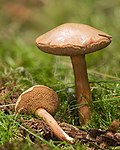 Chalciporus piperatus LC0182
 -
 Coloured Figures of English Fungi or Mushrooms - t. 34
 -
 2010-08-11 Chalciporus piperatus (Bull.) Bataille 99106
 -
 2006-09-10 Chalciporus piperatus 26645


_Bataille_99106.jpg)

