Cystine/glutamate transporter: Difference between revisions
CSV import |
CSV import |
||
| Line 25: | Line 25: | ||
[[Category:Biochemistry]] | [[Category:Biochemistry]] | ||
[[Category:Medical terminology]] | [[Category:Medical terminology]] | ||
== Cystine/glutamate_transporter == | |||
<gallery> | |||
File:PBB_GE_SLC7A11_217678_at_fs.png|PBB GE SLC7A11 217678 at fs | |||
File:Synapse_diag1.svg|Synapse diagram | |||
File:Porters.PNG|Porters | |||
File:Monosodium_glutamate.svg|Monosodium glutamate | |||
File:Cystine-3D-balls.png|Cystine 3D balls | |||
File:Alzheimers_disease-brain_shrinkage.gif|Alzheimer's disease brain shrinkage | |||
</gallery> | |||
Latest revision as of 01:00, 27 February 2025
Cystine/glutamate transporter (also known as system x_c^− or xCT) is a membrane transport protein that facilitates the exchange of extracellular cystine and intracellular glutamate across the cell membrane. This transporter is a key component of the glutathione biosynthesis pathway, which plays a crucial role in cellular redox regulation and detoxification processes.
Structure[edit]
The cystine/glutamate transporter is a heterodimeric protein complex composed of two subunits: a light chain, xCT, and a heavy chain, 4F2hc. The xCT subunit is responsible for the transport activity, while the 4F2hc subunit is required for the functional expression of xCT on the cell surface.
Function[edit]
The primary function of the cystine/glutamate transporter is to import cystine into cells, which is then reduced to cysteine for the synthesis of glutathione. Glutathione is a major cellular antioxidant that protects cells from oxidative stress. The transporter also exports glutamate, a neurotransmitter, into the extracellular space. This exchange process is important for maintaining the balance of these amino acids in the body.
Clinical significance[edit]
Alterations in the function of the cystine/glutamate transporter have been implicated in several diseases. For example, overexpression of xCT has been observed in various types of cancer, including glioma, melanoma, and breast cancer. This overexpression is thought to enhance the survival of cancer cells by increasing their antioxidant capacity. In contrast, reduced function of the transporter has been associated with neurodegenerative disorders such as Alzheimer's disease and Parkinson's disease, likely due to impaired glutathione synthesis and increased oxidative stress.
See also[edit]
References[edit]
<references />

Cystine/glutamate_transporter[edit]
-
 PBB GE SLC7A11 217678 at fs
 -
 Synapse diagram
 -
 Porters
 -
 Monosodium glutamate
 -
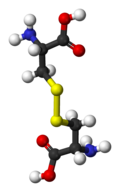 Cystine 3D balls
 -
 Alzheimer's disease brain shrinkage


