Baby sign language: Difference between revisions
CSV import |
CSV import |
||
| Line 33: | Line 33: | ||
[[Category:Non-verbal communication]] | [[Category:Non-verbal communication]] | ||
{{medicine-stub}} | {{medicine-stub}} | ||
== Baby_sign_language == | |||
<gallery> | |||
File:Child_using_sign_language.jpg|Child using sign language | |||
File:Eat_finish_en.jpg|Eat finish | |||
File:Mom_dad_en.jpg|Mom dad | |||
File:More_drink_en.jpg|More drink | |||
File:Play_now_en.jpg|Play now | |||
File:Tired_sleepy_hurt_en.jpg|Tired sleepy hurt | |||
File:Yes_no_en.jpg|Yes no | |||
File:Young_boy.jpg|Young boy | |||
</gallery> | |||
Latest revision as of 00:51, 27 February 2025
Baby Sign Language is a form of pre-verbal communication with infants and toddlers using hand gestures and signs before they are able to speak. This method of communication is often used by parents and caregivers to communicate with young children to reduce frustration, enhance bonding, and aid in the development of language skills. It involves teaching babies signs to express their needs, desires, and observations.
History[edit]
The concept of baby sign language has roots in research conducted on American Sign Language (ASL) with deaf children. In the 1980s, researchers Linda Acredolo and Susan Goodwyn conducted a study that showed babies who were taught sign language could communicate basic needs and desires before they could speak. This led to the popularization of baby sign language among hearing parents and their children.
Benefits[edit]
Research suggests several benefits of using baby sign language, including:
- Reduced Frustration: It allows babies to express their needs and wants, reducing frustration for both the baby and the parents.
- Enhanced Bonding: Parents who practice baby sign language often report a closer emotional bond with their child.
- Cognitive Development: Some studies suggest that learning sign language may enhance cognitive development and linguistic skills.
- Early Communication: It enables early communication, which can be rewarding for parents and children alike.
Teaching Baby Sign Language[edit]
To teach baby sign language, parents and caregivers can start with a few simple signs such as milk, more, eat, and sleep. It is important to say the word while making the sign to help the baby make the connection between the gesture and the verbal language. Consistency and repetition are key components of teaching baby sign language.
Signs to Start With[edit]
- Milk: Mimic milking a cow with your hand.
- More: Tap your fingertips together.
- Eat: Bring your fingers to your mouth.
- Sleep: Rest your head on your hands, mimicking sleep.
Resources[edit]
There are many resources available for parents interested in teaching their babies sign language, including books, websites, and classes. Some popular resources include:
- Baby Sign Language Classes: Many communities offer classes that teach parents how to communicate with their babies using sign language.
- Online Tutorials: Websites and social media platforms offer free tutorials and videos.
- Books: There are several books available that provide guides and dictionaries for baby sign language.
Conclusion[edit]
Baby sign language offers a unique opportunity for early communication between parents and their children. While it is not a substitute for verbal language, it can serve as a valuable tool for enhancing the parent-child bond, reducing frustration, and potentially aiding in the development of language and cognitive skills.

Baby_sign_language[edit]
-
 Child using sign language
 -
 Eat finish
 -
 Mom dad
 -
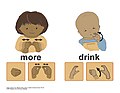 More drink
 -
 Play now
 -
 Tired sleepy hurt
 -
 Yes no
 -
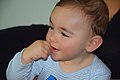 Young boy


