Cornu aspersum: Difference between revisions
CSV import |
CSV import |
||
| Line 28: | Line 28: | ||
[[Category:Gastropods of Europe]] | [[Category:Gastropods of Europe]] | ||
[[Category:Invasive species]] | [[Category:Invasive species]] | ||
== Cornu_aspersum == | |||
<gallery> | |||
File:Snail1web.jpg|Snail1web | |||
File:Snail-wiki-120-Zachi-Evenor.jpg|Snail-wiki-120-Zachi-Evenor | |||
File:Helix_aspersa_Sinistra_MHNT.CON.2002.767.768.jpg|Helix aspersa Sinistra MHNT.CON.2002.767.768 | |||
File:Helix_aspersa_mating.jpg|Helix aspersa mating | |||
File:Snail_eggs.jpg|Snail eggs | |||
File:Helix_aspera_hibernaculum.JPG|Helix aspera hibernaculum | |||
File:Escargot_sur_une_feuille.jpg|Escargot sur une feuille | |||
File:Snail_sanctuary^_-_geograph.org.uk_-_215817.jpg|Snail sanctuary | |||
</gallery> | |||
Latest revision as of 00:50, 27 February 2025
Cornu aspersum[edit]
Cornu aspersum, commonly known as the garden snail, is a species of land snail in the family Helicidae. It is one of the most well-known terrestrial mollusks and is native to the Mediterranean region, Western Europe, and parts of North Africa.
Description[edit]
The shell of Cornu aspersum is typically brown with yellowish or cream-colored bands and spots. The shell is globular and can reach a diameter of about 3 to 4 centimeters. The body of the snail is soft and slimy, with a distinct head that bears two pairs of tentacles. The upper pair of tentacles are longer and have eyes at their tips, while the lower pair are shorter and function as sensory organs.
Habitat[edit]
Cornu aspersum is highly adaptable and can be found in a variety of habitats, including gardens, forests, and urban areas. It prefers moist environments and is often found in areas with abundant vegetation. The snail is primarily nocturnal, coming out to feed during the night or after rain.
Diet[edit]
The diet of Cornu aspersum consists mainly of plant material. It feeds on a wide range of plants, including leaves, flowers, and fruits. This species is considered a pest in gardens and agricultural areas due to its feeding habits, which can cause significant damage to crops and ornamental plants.
Reproduction[edit]
Cornu aspersum is a hermaphrodite, meaning each individual possesses both male and female reproductive organs. During mating, two snails exchange sperm, and each can lay eggs. The eggs are laid in moist soil and hatch into juvenile snails after a few weeks.
Distribution[edit]
Originally native to the Mediterranean region, Cornu aspersum has been introduced to many parts of the world, including North America, South America, Australia, and New Zealand. It is often spread through human activities, such as the movement of plants and soil.
Related pages[edit]
Cornu_aspersum[edit]
-
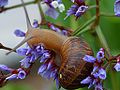 Snail1web
 -
 Snail-wiki-120-Zachi-Evenor
 -
 Helix aspersa Sinistra MHNT.CON.2002.767.768
 -
 Helix aspersa mating
 -
 Snail eggs
 -
 Helix aspera hibernaculum
 -
 Escargot sur une feuille
 -
 Snail sanctuary


